Choosing the right wall art above the sofa is one of those decisions that looks small and isn’t. It is the wall you look at most in the whole house: the one you see as you walk in, when you sit down to read and when friends come round. It is also the one that raises the most questions. One piece or several? What size? How high? Does it have to match the sofa? This guide answers all of that with real measurements, and offers a shortcut so you don’t have to guess.
The empty wall behind the couch after the renovation
It usually happens right at the end. The renovation is finished, the sofa has arrived, the linen, wood and light are all in place, and yet the living room wall looks dead. A print goes up, the usual way to fill the gap, and it is fine, but it looks like a catalogue page: flat, the same as in so many other homes. A finished house that says nothing isn’t fixed with another copy. It is fixed with one original piece of art that exists only once.
The worry is understandable: getting the scale, colour or height wrong on such a visible wall, just when you are finally ready to decorate it. The good news is that a few simple rules work almost every time, and you can test them on your own wall before you decide anything.
What to put above a sofa: one piece, a diptych or a gallery wall
This is the first question, and it is worth answering before the one about size. There are three routes, and among all the design ideas out there it helps to separate what works in a real home from what only looks good in a photo:
- One large piece. It gives the wall order, creates a single focal point and makes the room feel more spacious. It is the most serene option, and the one that works best in Mediterranean, Japandi or wabi-sabi living rooms.
- A diptych. If you hang two canvases, they should read as one work, with a breathing space of 5 to 10 cm (2 to 4 in) between them. It brings rhythm and symmetry, and helps when the sofa is very wide or a pillar or window breaks up the wall. There is more on pairs in our guide to diptychs and triptychs.
- A gallery wall. Two, three or more art pieces in different sizes. It can suit an eclectic style, but it demands precision: if the spacing or the heights don’t line up, the grouping looks messy rather than curated, whether you work in odd numbers or an even-numbered grid.
Why one large piece of art usually wins
One big painting or several small ones? In most living rooms, the answer is one large piece. Lots of small pictures break the wall up visually and make the eye jump from one to the next; a single statement piece lets it rest. A large work also holds its own against the scale of the furniture, something several small ones struggle to do. If you like the idea of a composition, the diptych is the middle ground: the rhythm of two pieces with the unity of one.
What rarely works as sofa wall decor is a shelf of objects or a large mirror as the default answer: they fill the expanse, but they don’t give it character. To really stand out, the couch wall needs one piece with a presence of its own.
What size wall art above a sofa?
The most reliable rule is the two-thirds rule: the artwork (or the pair, if it is a diptych) should cover about two-thirds of the width of the sofa. Any less and it looks lost, like a stamp on an envelope; any more and it starts to compete with the couch.
- A 180 cm (71 in) sofa: a work about 120 cm (47 in) wide, such as a 120×80 or a 120×90.
- A three-seater, 200 to 220 cm (79 to 87 in): between 130 and 160 cm (51 to 63 in) wide. This is the territory of a 130×75, a 140×70 or a 160×80.
- A sofa of 240 cm (94 in) or more: 160 cm and up. Here it is better to stretch the work sideways, with an oversized or panoramic horizontal format, than to push it higher.
Can a painting be wider than the sofa? It rarely works: the art should sit within the length of the seat, with air on both sides. Adriana regularly paints formats up to 2 metres (about 6½ ft) wide, and larger on commission, so a long wall doesn’t force you into several pieces. For an overview of formats, see our guide to large wall art sizes.
Horizontal, square or vertical
Above a couch, a horizontal format is almost always the most natural: it echoes the line of the backrest and opens the wall out to the sides. A square format, like the 105×104 cm pieces in the collection, works well over a two-seater or on a tall, narrow wall. A single vertical rarely fills the width; where it does make sense is in a pair, as in a diptych of two vertical canvases.
How high to hang art above a sofa
When you hang art over furniture, the most common mistake is hanging it too high. As a guide:
- Gap above the backrest: leave 15 to 25 cm (6 to 10 in) between the top of the sofa back and the bottom edge of the work. That way the sofa and the wall read as one. Beyond 30 cm (12 in), the art starts to float.
- Eye level: on a tall wall, the centre of the piece should sit about 145 to 155 cm (57 to 61 in) from the floor, roughly where a standing adult looks.
- Centring: centre the work on the sofa, not on the wall. If the couch is off-centre, so is the art. And if the wall has mouldings, wallpaper or wood panelling, respect its lines: the piece should fit within that frame with room to breathe.
To avoid surprises, cut a sheet of paper to the size of the work and tape it up with masking tape for a couple of days. You will see at once whether the scale and the height make the wall feel more balanced.
L-shaped sectionals, chaise longues and low ceilings
With a corner sofa or an L-shaped sectional, measure the section that runs along the wall you are decorating, not the whole piece of furniture, and centre the work on that stretch. If the chaise longue sits under the main wall, measure up to where it begins.
With low ceilings, around 250 cm (8 ft 2 in), a landscape format is your ally: keep the work 15 to 20 cm (6 to 8 in) above the backrest and choose a modest height of 70 to 80 cm (28 to 31 in). The top line stays low and the ceiling looks higher. And if the sofa floats in the middle of the room with plenty of space behind it, the wall behind the couch is no longer the main stage: the art usually works better on the wall you see from the sofa in front of it, perhaps above a fireplace.
Colour and style: pairing the art with your couch and cushions
The painting doesn’t need to share the colours of the upholstery. It works better when it talks to them:
- A neutral couch (linen, sand, beige, stone grey): the art can bring the accent, with sea blues or warm earth tones.
- A coloured couch (olive green, terracotta, blue): better a work in neutrals that picks up that colour in one detail, not across the whole surface.
- Cushions and throws are the bridge: repeat a colour from the cushions in the painting and the palette comes together on its own.
As for the style of the room and the rest of your living room decor, organic abstraction is the most forgiving choice. It doesn’t fight with the pattern of a rug or the wood of the coffee table or sideboard, and it adapts to your interior even as the rest of the room changes over the years, which is what makes it timeless rather than merely stylish. Figurative or botanical subjects date faster. If you want an even more pared-back version, take a look at our minimalist wall art.
Light: texture that changes through the day
The sofa wall usually gets side light, from a window, a floor lamp or a pair of sconces, and that light around the piece matters. For a work with matter and relief, that is the best light there is: raking light draws shadows across the texture and the piece changes from morning to night, softness in the afternoon, something moody by lamplight. A photo flattens all of that, which is why a textured work only truly makes sense on the wall. We go into it in detail in textured paintings.
Original contemporary art for the wall above your sofa
These pieces of original canvas art from the Mediterranean Collection 2026 come in formats that suit the most common sofas. All are originals, handmade in acrylic with matter, texture and relief, and signed by the artist:
- Silencio de Horizonte (160×80 cm): textures with acrylic glazes and Mediterranean light. For the longest sofas.
- Materia Serena (140×70 cm): neutral tones and calm organic textures, a modest height that suits low ceilings.
- Límites and Horizontes (130×75 cm each): paint, texture and asphalt paint, with a dark line that holds the composition together.
- Geografía del Alma (139×90 cm): where land meets sea, coastal without being literal, for walls with a little more height.
- Horizonte en Calma (120×90 cm): acrylic and matter, for mid-sized sofas and slightly taller walls.
- Equilibrio en Pétalos and Límite Natural (120×80 cm): a very versatile size for sofas of around 180 cm.
- Equilibrio en Movimiento, a vertical diptych of two 50×70 cm pieces, and Equilibrio, a diptych of two 60×50 cm pieces: for anyone who prefers the rhythm of two canvases.
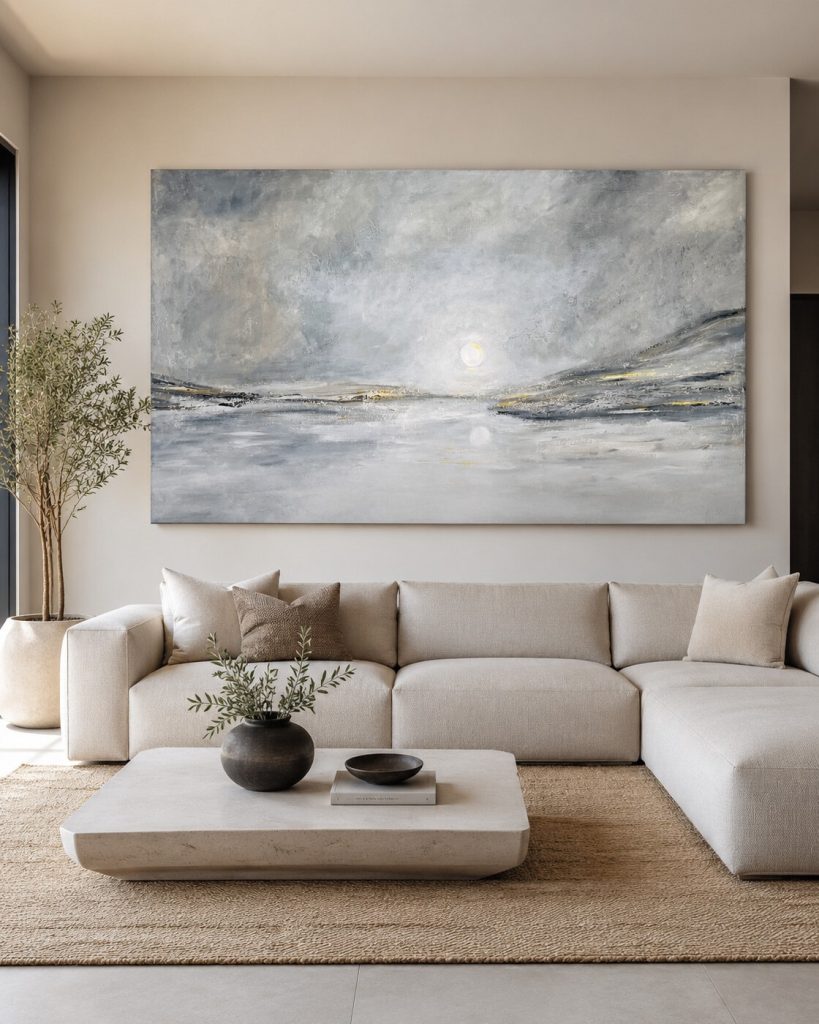 Silencio de Horizonte160 × 80 cmTextures with acrylic glazesPrice on requestAsk about this piece →
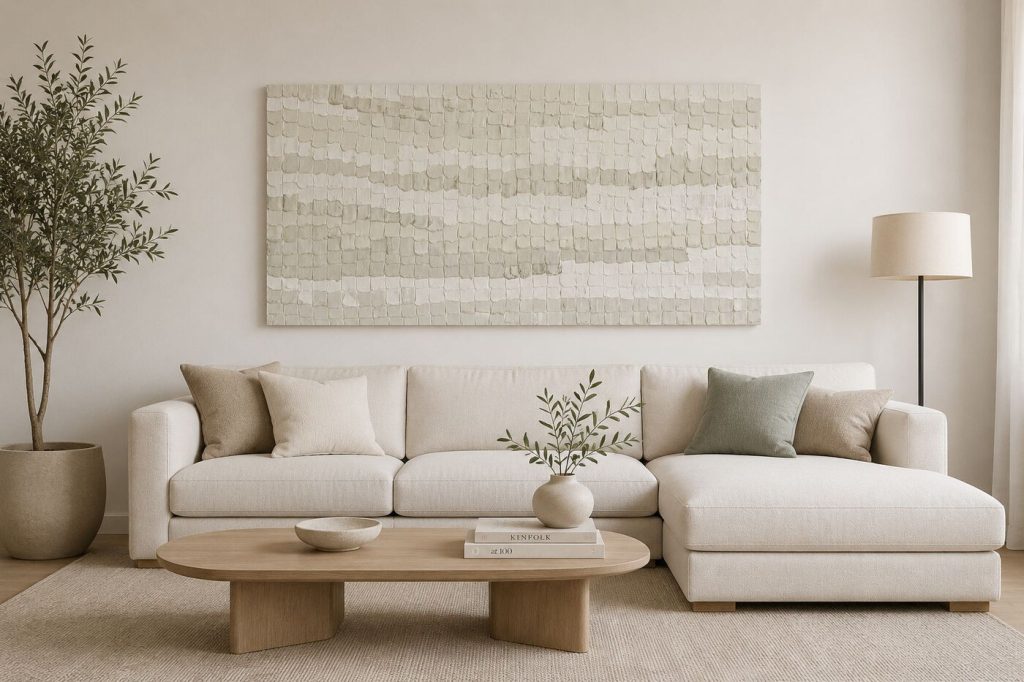 Materia Serena140 × 70 cmPaint and texture on canvasPrice on requestAsk about this piece →
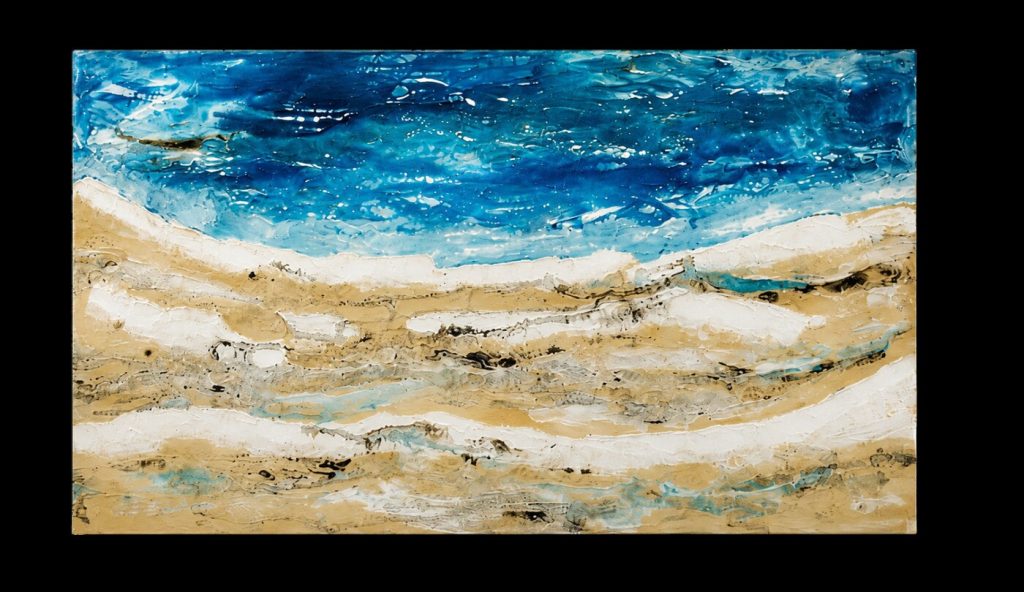 Límites130 × 75 cmPaint, texture and asphalt paint on canvasPrice on requestAsk about this piece →
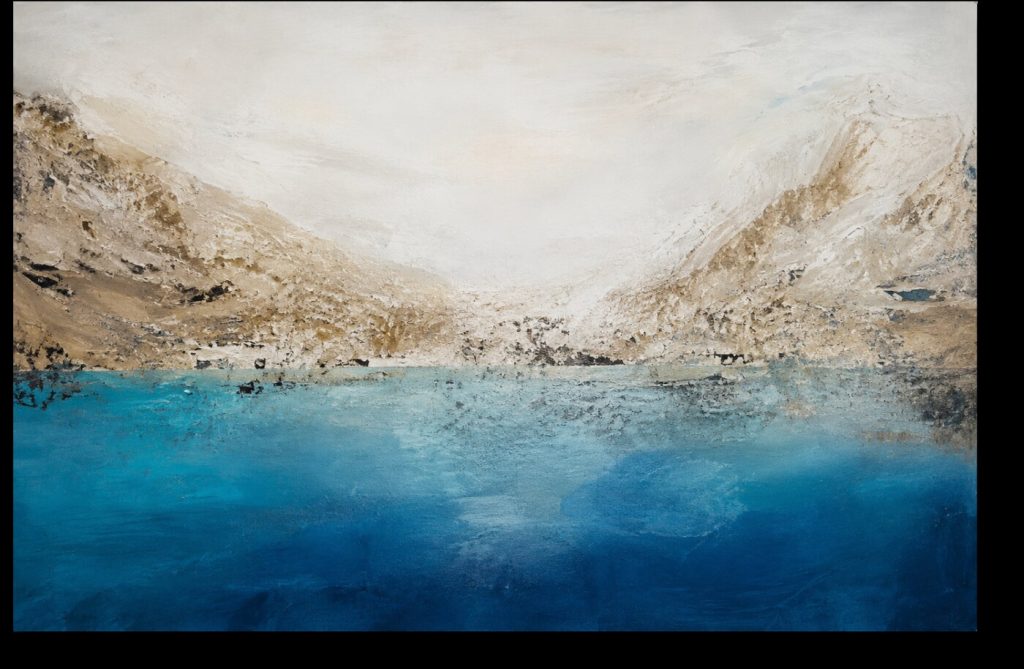 Horizontes130 × 75 cmPaint, texture and asphalt paint on canvasPrice on requestAsk about this piece →
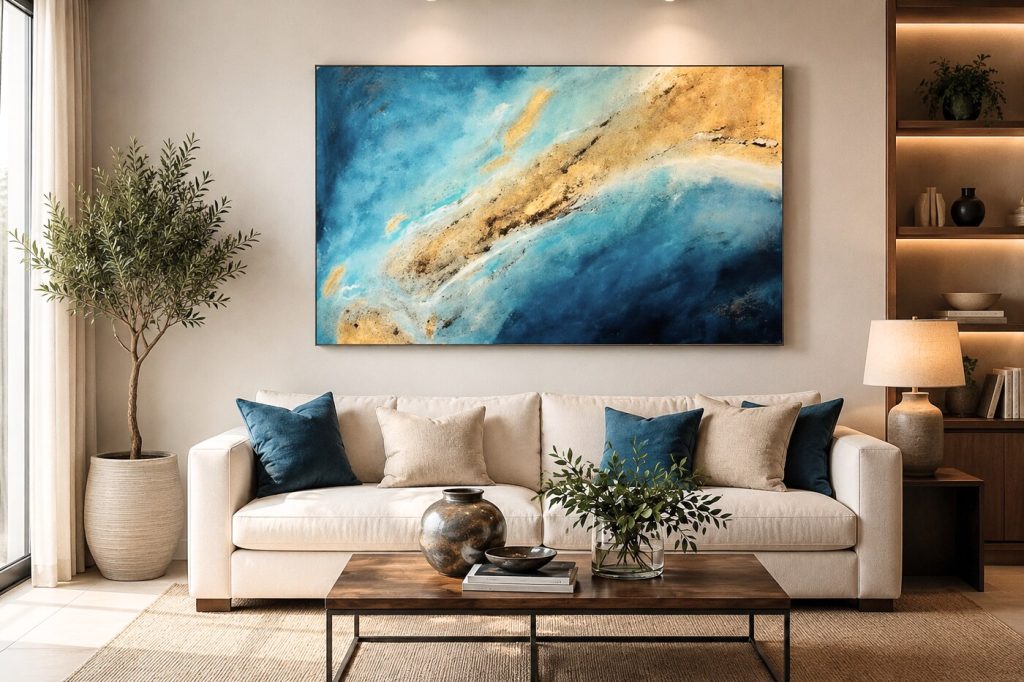 Geografía del Alma139 × 90 cmTextured paint on canvasPrice on requestAsk about this piece →
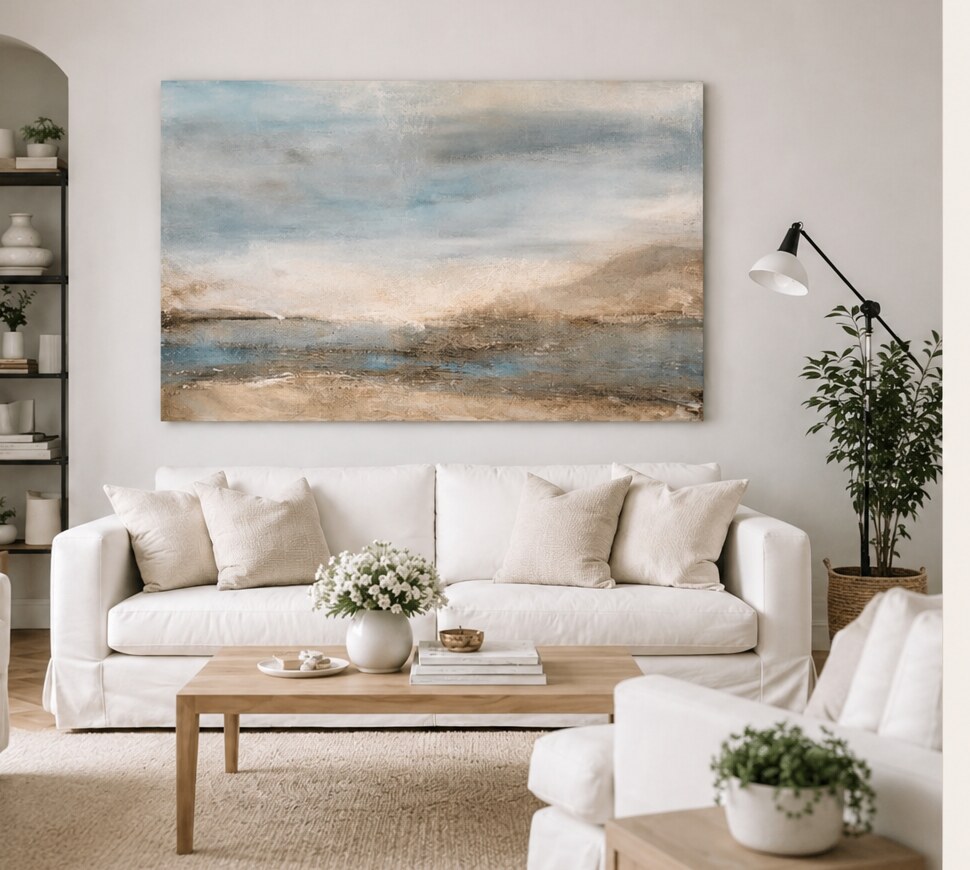 Horizonte en Calma120 × 90 cmAcrylic and textured matterPrice on requestAsk about this piece →
For more formats, browse our large abstract paintings, or read the guide to large living room art, which looks at the whole room rather than the sofa wall alone.
Common mistakes when hanging art above a sofa
- Too small. The most frequent mistake. If you are torn between two sizes, the larger one is nearly always right.
- Too high. The painting comes adrift from the backrest and the wall looks emptier than before.
- Off-centre. Centred on the wall but not on the sofa, or pushed aside by a socket or a lamp.
- A gallery wall with no plan. Pieces hung by eye, with uneven gaps, instead of one work chosen with intent.
- Choosing from a photo alone. Without testing the scale on your wall, and without seeing how the light in your living room changes the work.
Original or framed art from a shop: there is one, and it’s yours
Mass-produced framed art repeats the same image in thousands of homes. An original is something else: a texture you can touch, a signature and a certificate of authenticity that say this piece exists only once. It arrives stretched on a wooden stretcher frame, ready to hang, and the paint and texture continue around the edges, so it needs no frame. And it doesn’t stay behind with this renovation: you take it with you to your next home, like the furniture you truly love.
You don’t need to know the art world to choose one. There is no gallery and no middleman: you deal directly with Adriana Fernández, a Spanish contemporary artist who lives in Ibiza and paints in her studio in Ibiza town, and she helps you decide with concrete criteria of light, colour and scale. It works just as well when an interior design studio is furnishing the house, and Adriana can coordinate with them directly, and everything can be handled in English.
Send me a photo of your wall
The surest way to get it right is not to imagine it, but to see it. That is why the process starts with your living room, not with the painting:
- Free personal advice: you send a photo of the wall above your sofa and Adriana looks at the light, the tones, the furniture and the scale. A personal reply within 24 hours, by WhatsApp or email.
- A realistic simulation: you see the work to scale in your own living room before you decide. You can request your free wall simulation through the form.
- A commission if you need one: if no size fits, Adriana can paint a commissioned piece in the format, composition and colour palette of your room.
- Delivery across Spain with professional packaging, payment by Bizum or bank transfer, and direct contact with the artist.
And if you are still exploring, see the full collection of original abstract art.