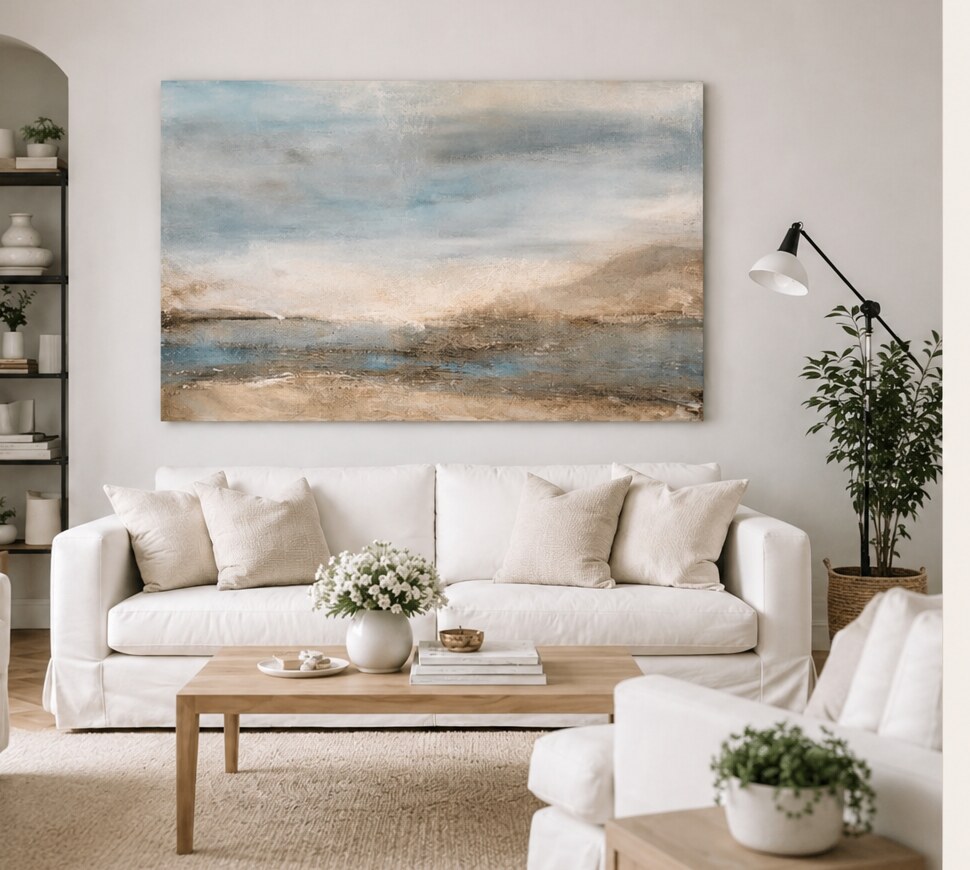
Good japandi wall art has nothing to do with bamboo stems, cherry blossom or a red sun on a beige background. It shares the values of the room it hangs in: honest materials, very few elements, calm, and an imperfection you can feel under your fingertips. If your living space already has linen, pale oak and walls in earthy tones, what it is missing is not another print or accessory but one original piece with real relief that holds that quiet together. This guide explains what japandi and wabi-sabi actually mean, which kind of artwork belongs in them, which colours and sizes work, and where to hang it.
What japandi interior design really is (and what it isn’t)
The japandi style brings together two design traditions that have more in common than they first appear to: the minimalism of Japanese interiors and Scandinavian simplicity: Japanese elegance meets the functionality of Scandinavian homes. The name is a blend of Japan and Scandi, and it became a design trend in the late 2010s, although the affinity between the two cultures goes back much further. From Scandinavian design it takes light, coziness and pale wood; from Japan, restraint, respect for empty space and a love of craft.
In practice, a japandi interior is defined by:
- Few pieces, carefully chosen. Every object has a purpose or a reason to be there.
- Natural elements: wood, linen, cotton, stone, ceramics, clay, paper.
- A palette that is neutral: warm white, sand, stone grey, earth tones and the odd dark accent.
- Clean lines and breathing space. Emptiness is not a gap to fill; it is part of the composition.
What japandi is not is a collection of postcard motifs. Fans, cranes, calligraphy used as a pattern, botanical line drawings or yet another reproduction of the Great Wave by Katsushika Hokusai belong to the souvenir shop rather than the style. Japanese art deserves better than being reduced to a motif. A painting for a japandi home doesn’t need to depict Japan; it simply needs to speak the same language as the room.
Wabi-sabi: the beauty of imperfection
Wabi-sabi is older and deeper than japandi. It is a Japanese aesthetic sensibility, closely tied to the tradition of the tea ceremony, that finds beauty in what is simple, imperfect, incomplete and marked by time. Wabi suggests a quiet, austere, almost humble beauty; sabi, the patina that years leave on a material. A ceramic bowl with an uneven rim, a worn timber beam, a stone wall softened by moss: that is wabi-sabi. A flawless, glossy surface is not.
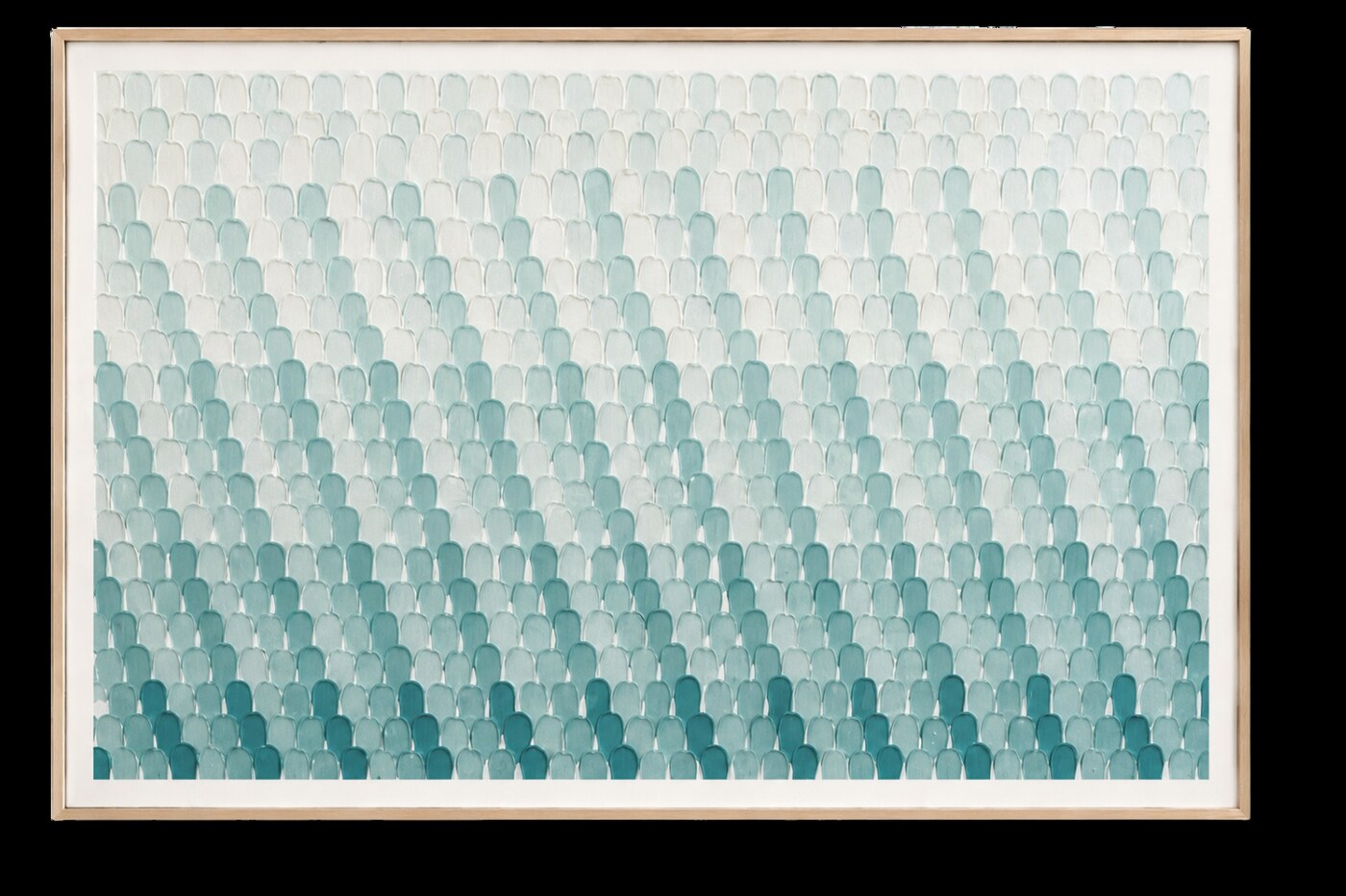
That is why wabi sabi wall art is defined less by subject than by attitude. It accepts irregularity, lets the movement of the hand show, works with surfaces that look weathered and prefers harmony to perfection. It is an idea that leads straight to matter painting, abstraction built from the material itself.
Japandi vs wabi-sabi: the difference
They are often mentioned in the same breath, but they are not the same thing. Japandi is a design style: order, function, clean lines. Wabi-sabi is a philosophy of beauty: the rough, the asymmetrical, what ages well. A japandi living room can be very polished; a wabi-sabi one welcomes the crack and the wear. They meet on the wall: an artwork that is restrained in composition and alive on the surface serves both.
Why abstract wall art with texture suits a japandi home
In a room with so few objects, the artwork becomes the focal point. A figurative picture with too much story breaks the calm; a flat, mass-produced surface wears out in weeks. An abstract painting with matter solves both: it doesn’t impose a narrative, yet it has real depth.
- A surface you can touch. Adriana Fernández’s paintings are made in acrylic with textured matter, relief and, in some pieces, asphalt paint. The surface has body, like the ceramics and stone around it. There is more on this in textured paintings with relief.
- Intentional imperfection. Edges that blur, layers that let the one beneath show through, areas where the matter builds up and others where it almost disappears. The logic of wabi-sabi, carried onto canvas.
- A calm composition. Horizons, lines of land, light set against shadow. Very few elements, organic forms and a sense of tranquility.
- Light that changes. Low morning light draws shadows across the relief; in the afternoon the piece softens and flattens. It never looks quite the same twice.
Print vs original: this can’t be printed
Most japandi wall art prints are exactly that: a print. Even a high-resolution art print with pigment inks on acid-free paper is flat; light slides across it and finds nothing. A print shows you a picture of matter; it can’t give you the matter itself. An original has real shadows, the marks of the hand and a single existence. Every work is signed and comes with a certificate of authenticity. There is one, and it is yours.
The Mediterranean and wabi-sabi: one idea, two shores
People drawn to japandi or wabi sabi are often drawn to the Mediterranean house too, and that is no coincidence. Flaking limewash, dry-stone walls, timber bleached by the sun, crumpled linen and handmade pottery are all, in their own way, wabi-sabi: simple beauty that improves with time. The landscape changes; the sensibility doesn’t.
Adriana’s work comes from that other side of the map: the Mediterranean sea, coastal erosion, the line where land meets water, silence. She lives in Ibiza and paints in her studio in Ibiza town, surrounded by that light. That is why her pieces sit so naturally in a japandi or wabi-sabi home: not because they quote the East, but because they share the same roots in natural materials, imperfection and calm. A villa with exposed beams, a linen sofa and a canvas worked like sand and stone is japandi, Mediterranean and wabi-sabi all at once, a serene harmony between two cultures. Your villa is in Spain; your art can be too. More on that in art from Ibiza.
Neutral wall art: a japandi colour palette
Japandi works within a narrow range. The painting should pick up one or two tones already in the room and add nuance, not introduce a new colour that competes.
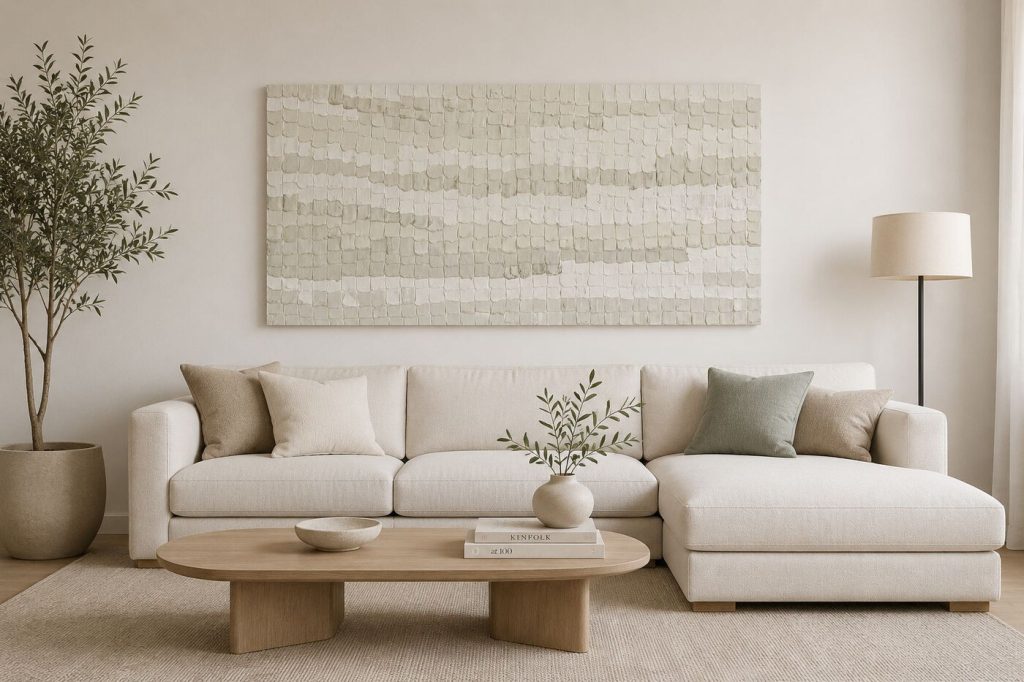
- Sand, linen and off-white. The most versatile base for a neutral wall, with pale wood, linen and limewash. In a piece with relief, these tones let the surface take the lead, as in white textured art.
- Earth, soft ochre and muted terracotta. They bring Scandinavian warmth to a space that risks feeling cold.
- Stone grey and a very muted sage. Good companions for ceramics, plants and polished plaster floors.
- One dark accent. Charcoal black or deep brown anchors the composition, the way a single dark wooden piece anchors a pale room. In works such as Límites or Límite Natural, that counterpoint comes from asphalt paint.
Avoid loud, saturated colour: in a japandi room it jumps out and upsets the balance. If the space is very neutral, let contrast come from the relief rather than the colour. The result is understated, timeless and harmonious.
Best japandi wall art ideas from the Mediterranean Collection 2026
All 13 works in the collection are one-offs, painted in 2026, signed and stretched on a wooden stretcher. These are the ones that sit best in a japandi or wabi-sabi interior:
- Materia Serena (140×70 cm). Paint and matter in neutral tones, calm and organic. Probably the most japandi piece in the collection.
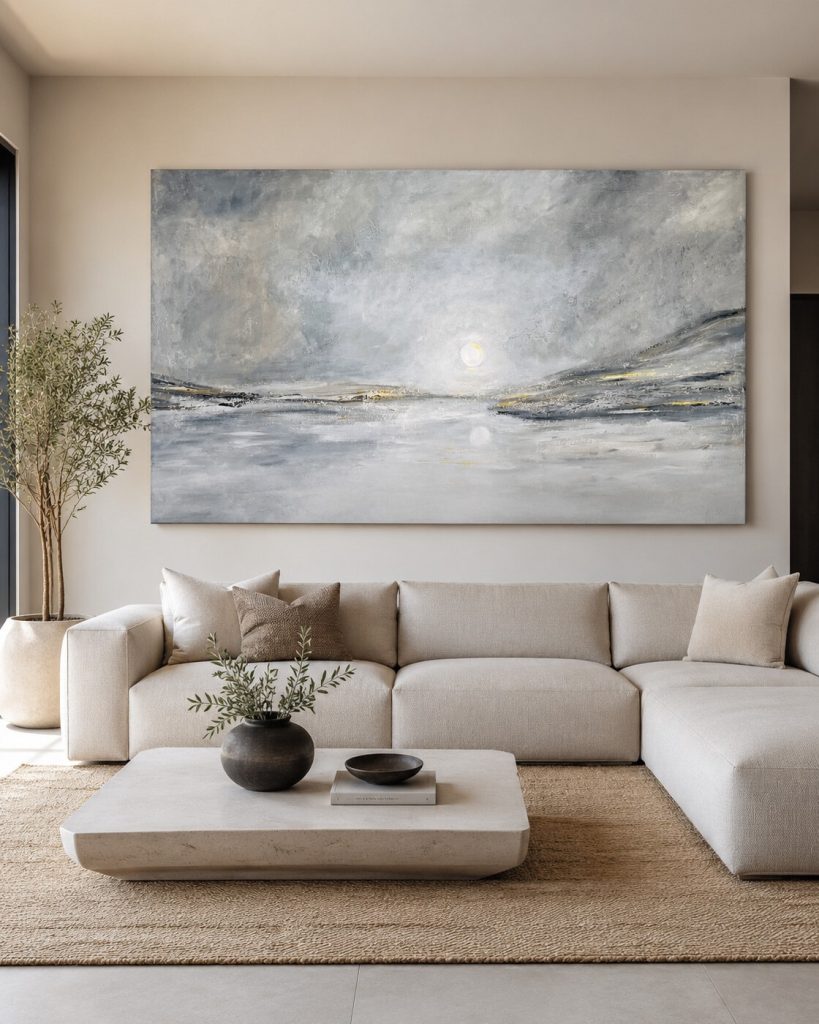
- Silencio de Horizonte (160×80 cm). Textures with acrylic glazes and Mediterranean light. An almost white horizon, perfect above a linen sofa.
- Equilibrio en Pétalos (120×80 cm). Paint and matter that recall coastal erosion: wabi-sabi at its purest, time at work on matter.
- Límites and Horizontes (130×75 cm each). Paint, matter and asphalt paint. A dark accent for pale rooms.
- Horizonte en Calma (120×90 cm). Acrylic and matter in a serene composition.
- Mareas Serenas (set of 30×30 cm). Textured relief and acrylic in a small format, for shelves, nooks or a narrow hallway.
Size and format: one piece rather than a gallery wall
Japandi prefers one work with presence to a gallery wall crowded with pictures. Curate, don’t collect. A single large piece organises the room and leaves space around it, which in this style matters as much as the artwork itself.
- Living room wall art above a sofa or bed: around two thirds of the width of the furniture. For a 200 cm sofa, a work 130 to 140 cm wide, such as Límites or Materia Serena.
- On a free wall: the piece can be larger, as long as there is air on either side. Adriana regularly paints formats up to 2 metres wide, and larger on commission, in a custom size. See large abstract paintings for more on scale.
- Diptychs: the vertical Equilibrio en Movimiento (two pieces of 50×70 cm) adds rhythm without breaking the calm. More ideas in diptych and triptych art.
- Square formats: Costa de Ibiza and Profundidades (105×104 cm) suit tall walls, home offices and a reading nook.
Where to hang japandi art in modern homes
Living room
The natural place: above the sofa, over a low wooden sideboard or on the wall you see as you walk in. Hang the centre of the work about 145–155 cm from the floor and keep the rest of that wall clear.
Bedroom
In the bedroom japandi becomes even quieter. A calm, horizontal piece above the headboard, in sand or stone tones, brings a zen wall and a moment of serenity at the end of the day.
Dining room and hallway
In a dining room with a solid wood table, a large work above the sideboard gives the space its focal point. In a narrow entrance, the Mareas Serenas set or a vertical format is enough.
Frame options: none needed
The works don’t need framing. They arrive stretched on a wooden stretcher, ready to hang, with the paint and texture continuing around the edges. Seen from the side, the piece reads as something made by hand, like a ceramic bowl. In a japandi room, the painted edge is usually the most honest finish, and the essence of japandi: nothing added that isn’t needed.
Send a photo of your wall
Choosing a piece of home decor for a room you have planned so thoughtfully can feel daunting. Is the scale right? Will the tone work with the sofa? Will the texture show? So the process starts with your wall, not with a catalogue. You send a photo, Adriana looks at the light, tones, furniture and scale, and prepares a realistic simulation of the piece on your own wall before you decide anything. The advice is personal, free, and you get a reply within 24 hours.
If nothing in the collection fits perfectly, you can commission a piece in the size, palette and composition of your home. Everything can be handled in English, by WhatsApp or email, directly with the artist and with no middlemen. Delivery is across Spain with professional packaging, and payment is by Bizum or bank transfer.