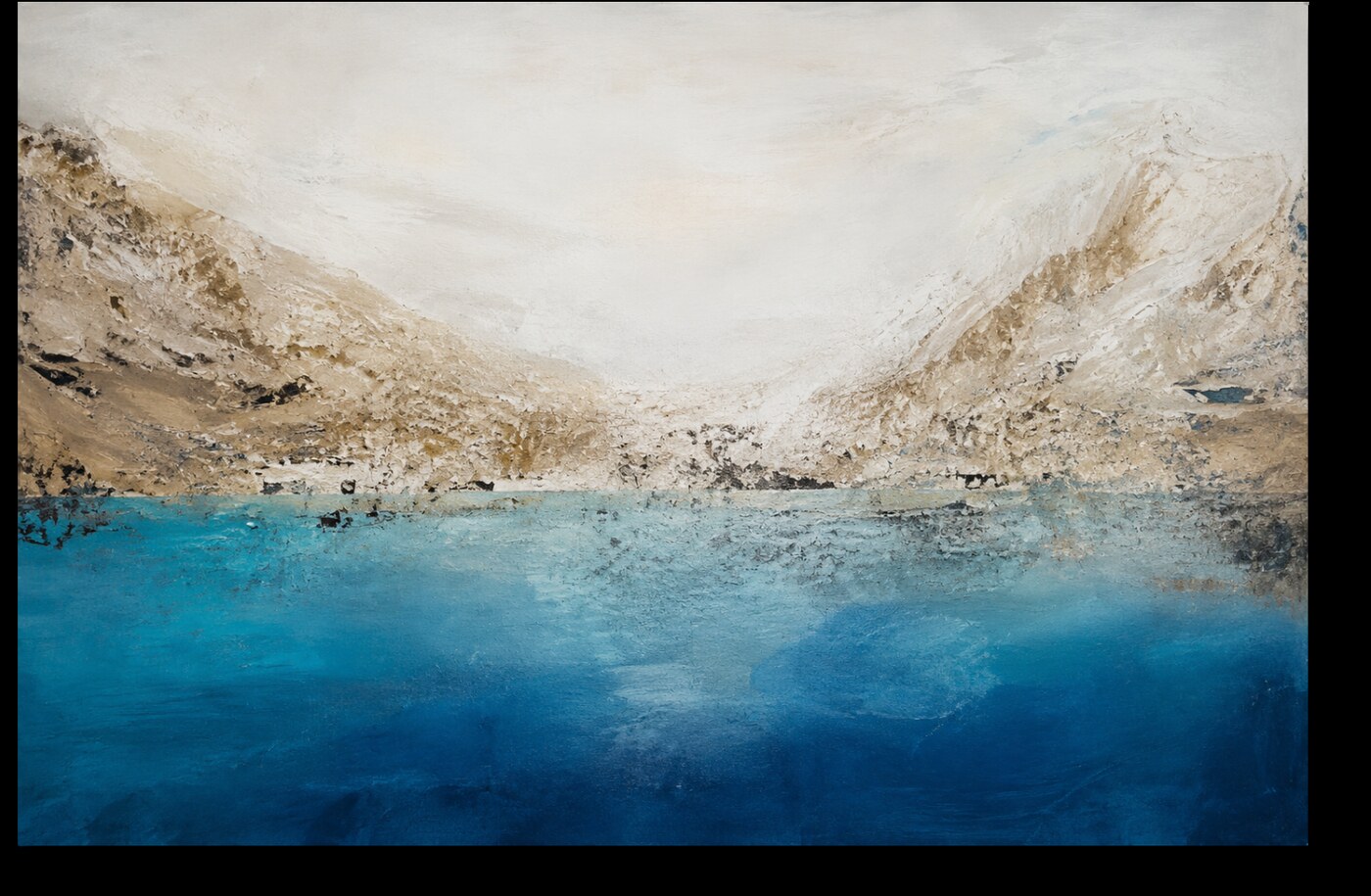
The right hallway wall art does a quiet but important job: it is the first impression anyone gets as the door opens, and the last thing you see on your way out. Yet the entrance is usually the wall that gets left until last, with an old nail, an inherited mirror or a bare space above the console table that nobody quite knows how to fill. This guide covers size, hanging height, light and colour for entrance halls and long passages, using the real dimensions of original works, and a simple way to see the piece on your own wall before you decide.
The empty hallway in a finished house
It tends to happen right at the end. The renovation is done, the furniture has arrived, the linen, wood and stone are all in place, and the entrance still says nothing. A framed print goes up and it looks fine but generic, decor rather than wall art, the same as a thousand other front doors. A finished house that says nothing isn’t fixed by another copy. It is fixed by one original piece that exists only once.
Every work in Adriana Fernández’s Mediterranean Collection 2026 is painted by hand in acrylic with matter, relief and asphalt paint, in her studio in Ibiza town. Each one is signed and comes with a certificate of authenticity: there is one, and it’s yours. Not decor to fill a gap, but fine art to live with, and the start of an art collection you can take to your next home.
What kind of wall art works in a hallway
As you come in, the eye moves quickly, so the right art reads at a glance and sets the tone for your home. A few principles to choose artwork for the hallway:
- One piece with presence rather than a cluster of small art prints in matching frames. It gives the wall order and a sense of calm from the doorway.
- Abstract and organic rather than figurative: an abstract painting sits easily with any style, from Mediterranean to Japandi or minimalist, without competing with the rest of the house.
- Texture over gloss: in a space with little light, matter gives depth where flat colour simply fades. It is what separates an original painting from a print, however good the print.
- A link to the living room: if you can see through to the sitting area from the front door, the piece by the door can hint at one of its tones.
One statement piece or a small gallery wall?
Many entrance ideas start with a collection of small frames on a ledge or a staircase. It can look chic in a large house with high ceilings, but in a typical entrance it is hard to curate: spacing has to be exact, and the result easily feels busy. One large original does the opposite. It makes a statement without clutter, gives the wall a clear centre and makes an entrance feel calm and considered. If you like the rhythm of several pieces, a diptych or a small gallery wall of the Mareas Serenas set gives you that rhythm while keeping one cohesive palette.
What size art for a hallway or entryway?
Format and size depend on what sits beneath the piece and how far away you stand to look at it. In a hallway you are almost always close, so measure the work against the furniture and the free wall, not against the whole house.
Above a console table or sideboard
Use the same rule as above a sofa: the artwork should span around two-thirds of the width of the furniture. In real numbers:
- Console table of 100 to 120 cm: a work around 70 to 80 cm wide, or the Mareas Serenas set of 30×30 cm pieces hung in a row or a grid.
- Sideboard of 140 to 160 cm: a square format such as Costa de Ibiza or Profundidades (105×104 cm), or a vertical diptych like Equilibrio en Movimiento (two pieces of 50×70 cm), which spans roughly 105 to 110 cm with its gap.
- Furniture of 180 cm or more: this is where one large statement piece belongs: a 120×80 cm work such as Equilibrio en Pétalos or Límite Natural, or Horizonte en Calma at 120×90 cm.
On a wall with no furniture
Without a console, the free wall is the perfect place to let the art speak. Let it guide you: leave breathing space either side and aim for the work to cover about half of the available width. In a narrow entrance, it is better to have a little too much wall than a painting that brushes the corners. And if your wall needs a size the collection doesn’t have, Adriana regularly paints formats up to 2 metres wide and, on commission, larger still. For more on scale, see large abstract paintings.
How high to hang art in an entrance hall, and spacing
- Centre at eye level: on a free wall, the centre of the work sits around 145 to 155 cm from the floor.
- Above a console: leave 15 to 25 cm between the top of the furniture and the bottom edge of the painting, so they read as one composition. If there is a lamp or a tall vase on top, go a little higher, but no more than 30 cm.
- Facing the front door: the wall you see as the door opens is the best spot. If the door hides it when open, choose another.
- Centre it on the furniture, not on the wall.
Before you decorate, cut a sheet of paper to the exact size and tape it up with masking tape for a couple of days. You’ll walk past it enough times to know whether the scale works. Every piece arrives stretched on a wooden stretcher frame, ready to hang, in a sleek, clean profile, and because the paint and texture continue around the edges, it needs no frame.
Dark hallways: why texture and raking light matter
Most entrance halls have little natural light, or none at all. That is where a flat print loses almost everything and a textured original comes into its own. When light falls from the side, from a table lamp or a spotlight angled at the wall, raking light runs across the surface and every ridge of matter casts its own small shadow. The piece changes depending on which lamp is on, and in the evening it is not the same painting you passed in the morning. This is the part that can’t be printed: a photo or a print flattens texture, and in a dim space that difference is even more obvious.
- Place the light to one side and close to the wall, not straight on: frontal light flattens relief.
- Choose warm light, which brings out earth and sand tones.
- In a very dark entrance, go for lighter tones with strong relief, such as Materia Serena (140×70 cm), with its neutral palette and organic textures, or a piece of white textured art.
There is more on how those surfaces are built in textured paintings.
Wall art for a long corridor or landing
A long hallway has its own logic: you look at it while moving, and rarely head-on. Two approaches work well.
Horizontal pieces that follow the walk
A long, horizontal work follows the direction you walk in and visually stretches the space. Silencio de Horizonte (160×80 cm), built from textures and acrylic glazes that recall Mediterranean light, or Materia Serena (140×70 cm) suit a corridor at least 1.10 m wide, where you can step back far enough to see them. Límites and Horizontes (130×75 cm), with asphalt paint, bring deeper, bolder contrast to a pale passage.
At the end of the passage
If the walk ends in a wall, that wall belongs to a painting. You see it whole from a distance and it gives the walk a destination. Here a square or portrait format works better than a very wide one, and it becomes the focal point of the whole walk.
Portrait-format diptychs for narrow hallways
In narrow spaces, beside a stair or in the stretch between two doors, a vertical diptych gains height without crowding the way through. Equilibrio en Movimiento, two pieces of 50×70 cm inspired by the fluidity of water, reads as one work when hung 5 to 10 cm apart. More on pairs in diptych and triptych art.
A selection of large formats from the collection, every one a unique original on canvas:
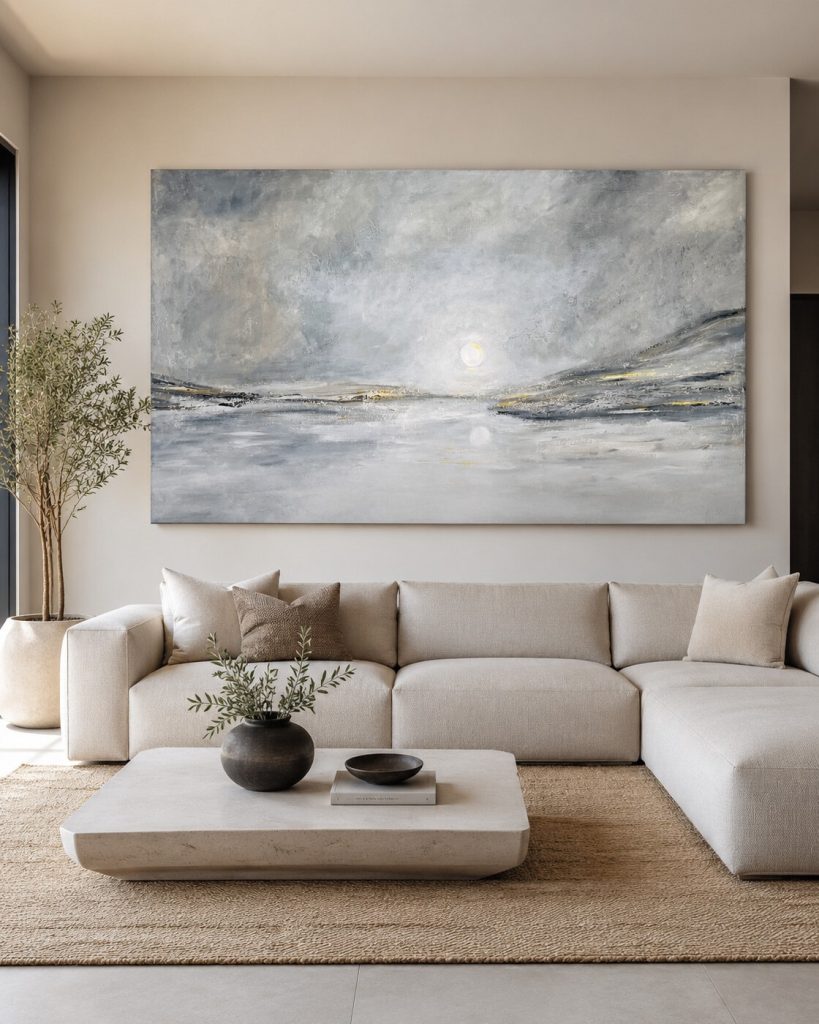 Silencio de Horizonte160 × 80 cmTextures with acrylic glazesPrice on requestAsk about this piece →
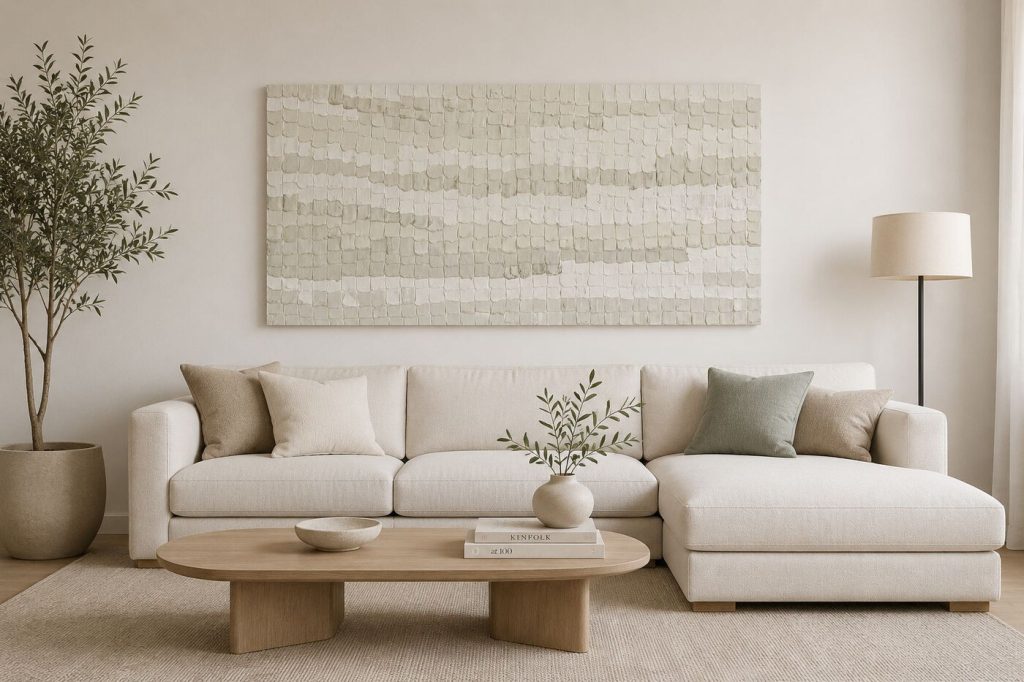 Materia Serena140 × 70 cmPaint and texture on canvasPrice on requestAsk about this piece →
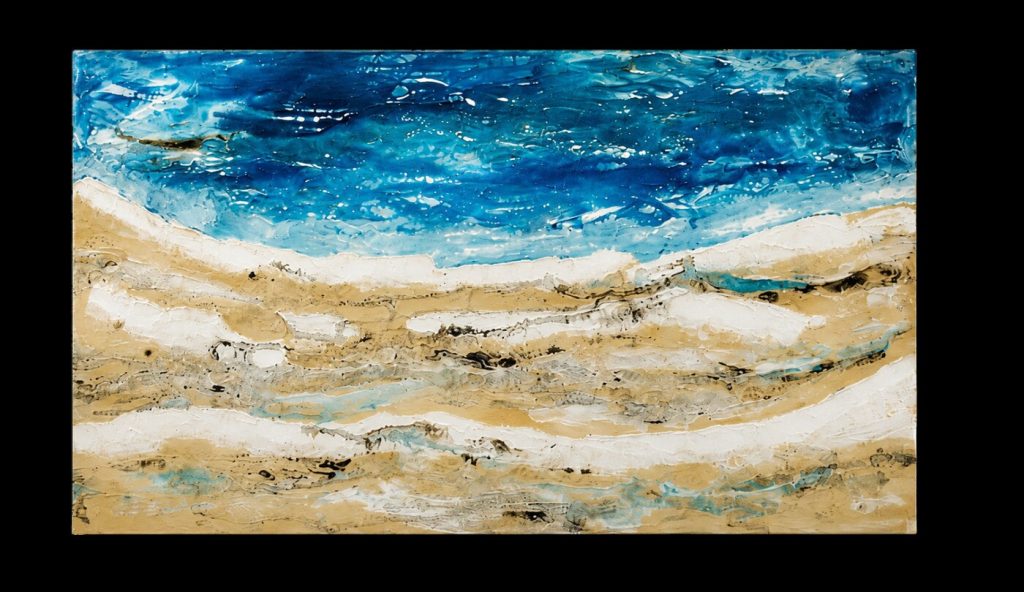 Límites130 × 75 cmPaint, texture and asphalt paint on canvasPrice on requestAsk about this piece →
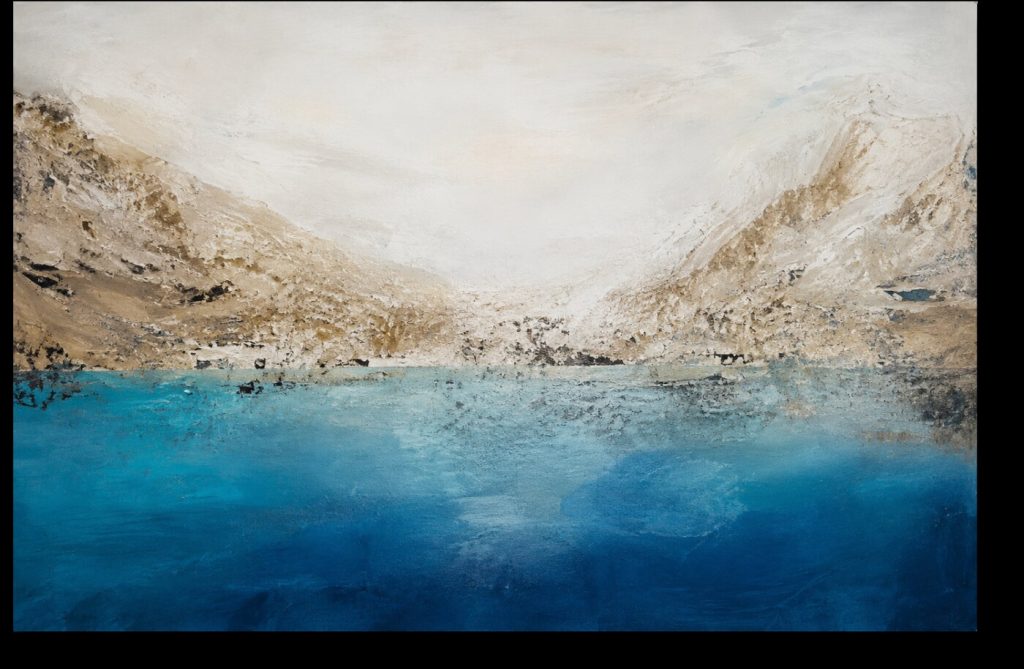 Horizontes130 × 75 cmPaint, texture and asphalt paint on canvasPrice on requestAsk about this piece →
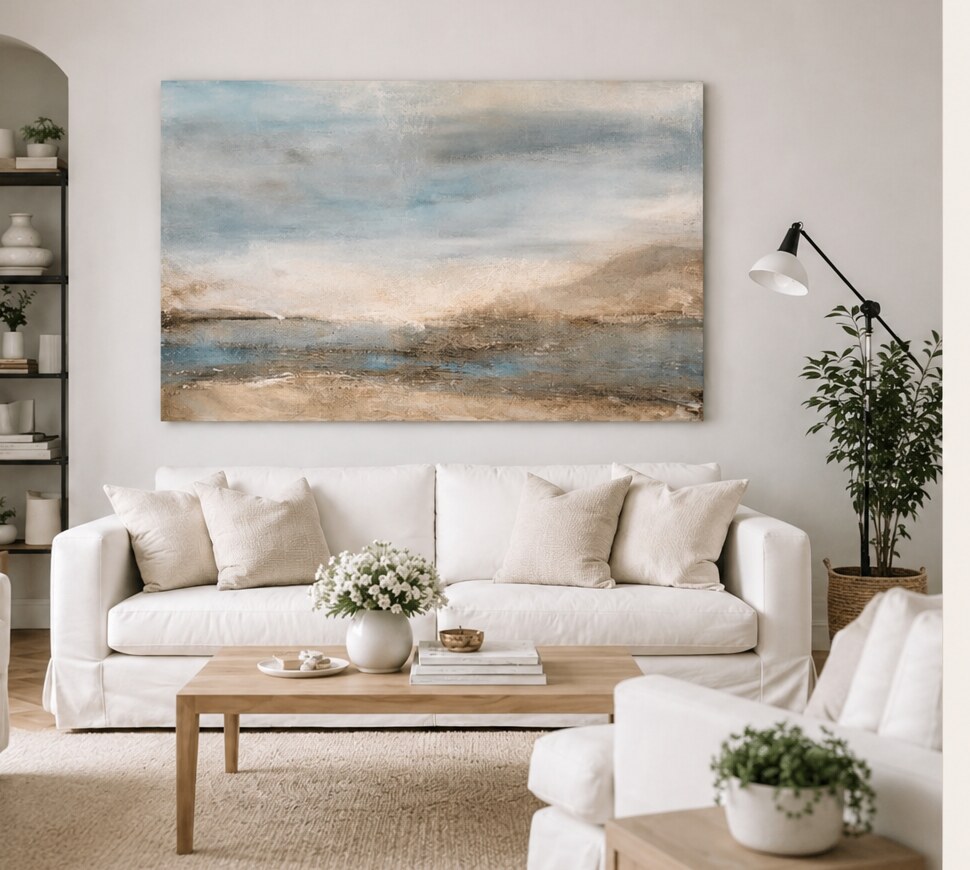 Horizonte en Calma120 × 90 cmAcrylic and textured matterPrice on requestAsk about this piece →
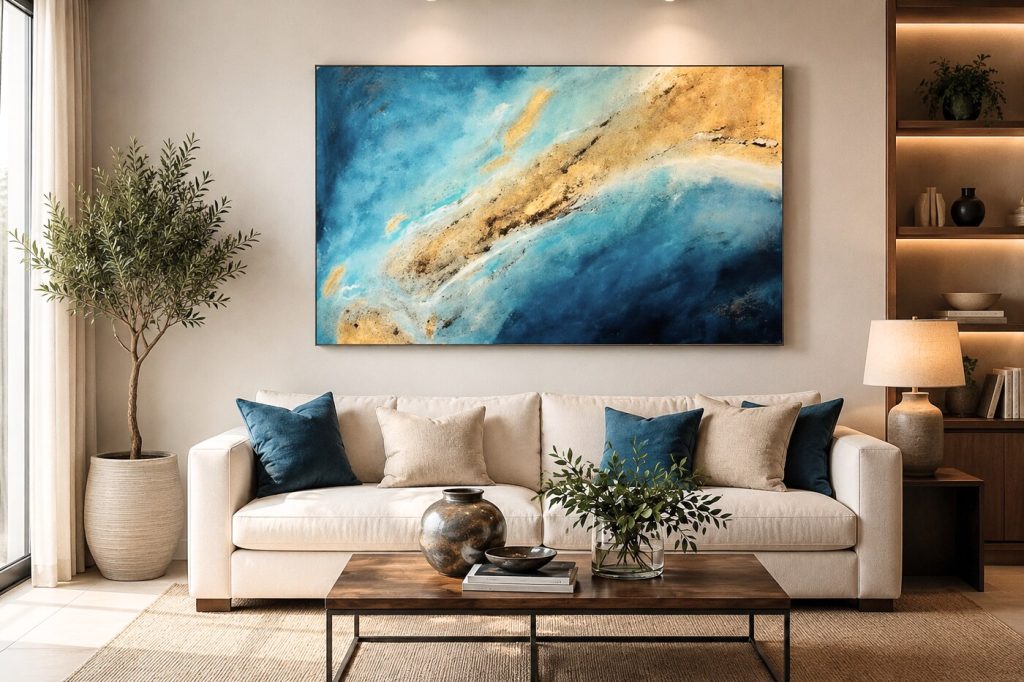 Geografía del Alma139 × 90 cmTextured paint on canvasPrice on requestAsk about this piece →
Mirror or painting in the entrance hall?
A mirror by the door is useful: a last look before you leave, and it can bounce light around a dim entrance. But a mirror only reflects what is in front of it; it brings nothing of its own. The arrangement that usually works best is to share the walls: the mirror on a side wall or by the door, the artwork on the main wall, the one you see as you come in. If there is only one wall, decide what you need more: a mirror, however playful or colourful its frame, reflects the room; a painting gives it a centre. In an entrance that is already bright, the painting will give it character; in a tiny one with no window, the mirror may win and the painting can move to the corridor.
Colour ideas for a welcoming hallway
The colour doesn’t need to match a painted door, the runner or the floor. It only needs to talk to them, and to whatever you can see beyond.
- Warm neutrals (sand, off-white, ochre, warm grey) make the space feel wider and calmer, and sit naturally with wood, stone and linen.
- Mediterranean blues bring colour without noise: if the house looks towards the sea or the living room is full of light, they bring that light right to the front door and make a more welcome first step inside. See the sea paintings.
- Bold, deep contrasts with asphalt paint, for white, bright entrances that need an anchor, such as Límite Natural or Horizontes.
Small hallways and entryways
In a very small entryway, one medium piece or the Mareas Serenas set works better than a crowded wall of frames: fewer pieces, more calm. Let the artwork be the only thing on that wall and keep coats, keys and shelves away from it: a small, uncluttered entrance is already a welcoming space.
Your villa is in Spain. Is your art?
If you have a home on the Mediterranean, in Ibiza, Mallorca or on the Costa del Sol, the hallway is where it can say so first. Coastal art made far away, then printed in bulk, rarely carries that. A piece of art painted in Ibiza does. Adriana’s work comes from that same landscape: horizons that blur, coastal erosion, the line where land meets sea. More on that in art from Ibiza.
Send a photo of your hallway
The surest way to get it right is not to imagine it, but to see it. Send Adriana a photo of your entrance and she will look at the light, tones, furniture and scale, suggest the piece that fits and prepare a realistic simulation on your own wall, free of charge, with a personal reply within 24 hours. If nothing in the collection suits your space, she can paint a commission in the size, palette and composition it needs.
Everything can be handled in English, by WhatsApp or email, directly with the artist and with no middlemen. Payment is by Bizum or bank transfer, and delivery covers all of Spain with professional packaging. The piece arrives signed, with its certificate of authenticity, ready to hang. Interior designers working on the interior design of a villa can ask for a commission to match a palette or a specific wall, or plan a cohesive visual thread of hallway art from the front door to the living room wall.