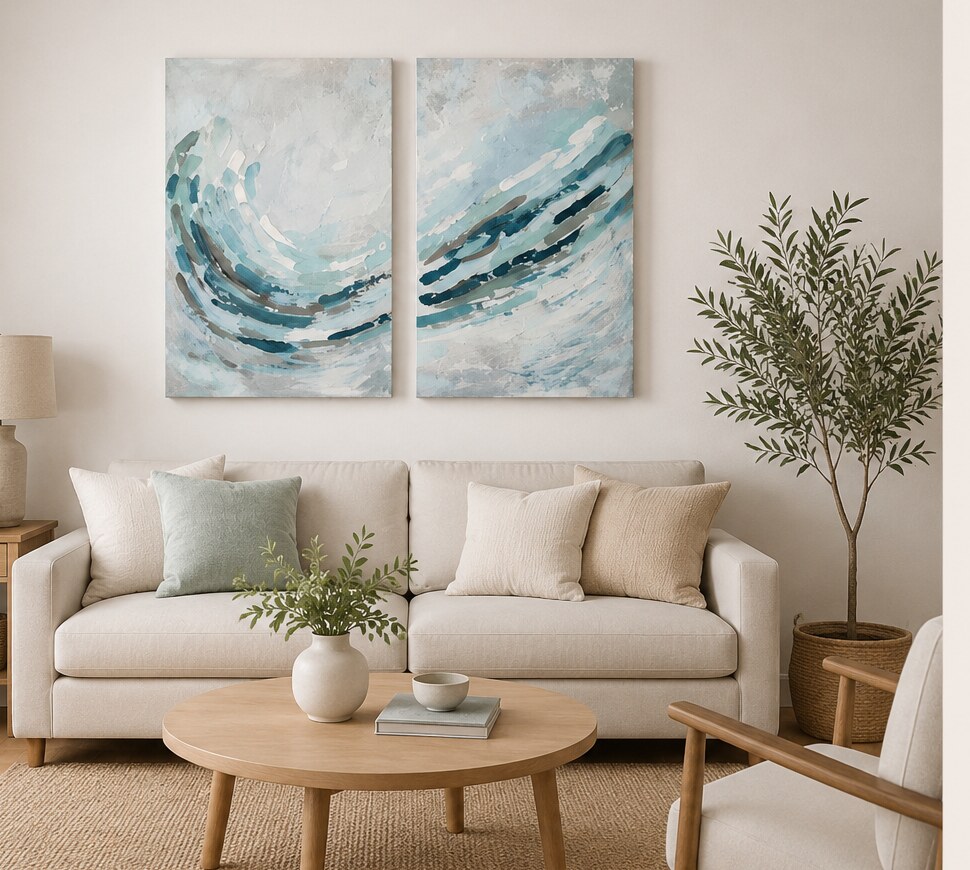
Diptych wall art splits one painting across two canvases, so that the wall breathes between them. Chosen well, a diptych settles a long living room wall, frames a bed or rescues a wall broken up by a window. Chosen badly, it reads as separate panels that just happen to hang together. This guide covers what a diptych is, how it differs from a triptych, when it beats a single large piece, how much spacing to leave and how to hang it, and shows the diptychs Adriana Fernández painted in Ibiza for her Mediterranean Collection 2026.
What is diptych wall art?
A diptych is one piece of art conceived in two panels that are displayed together. The two paintings are not simply a matching pair: the composition crosses the gap, so a line, a colour or a texture starts on one panel and carries on into the next, creating a visual connection between them. The empty space in the middle is part of the work, like a pause in a sentence. The result is a single composition in two parts, cohesive rather than repetitive.
- Diptych: two panels in conversation. Intimate and flexible, it can hang side by side, vertically, or even across two walls that adjoin at a corner.
- Triptych: the same idea in three panels, usually with the centre panel as the anchor.
- Set of 2 or set of 3: separate pieces from one series, related in palette but each complete on its own.
A short art history of the diptych
The art form is far older than modern home decor. In late antiquity, a newly appointed Roman consul would hand out consular diptychs: small portable ivory tablets, finely carved, joined by a hinge so they could close like a book. In medieval times, diptychs, painted or carved, moved into churches and private devotion, alongside the larger altarpieces of the Gothic period. The best known is the Wilton Diptych, a small portable altarpiece from the late fourteenth century, with the English king Richard II and three saints on one panel and the Virgin Mary, holding the Christ Child among angels, on the other: a Madonna painted for a king’s private prayers.
In the twentieth century the diptych left religious painting behind. Andy Warhol’s Marilyn Diptych (1962), now at Tate, set fifty repeated images of Marilyn Monroe across two panels, one bright and one fading. Today the art of the diptych is just as much at home in contemporary abstract art as in portraiture or photography: two panels, one idea.
Diptych or one large painting?
The real question is not which format is prettier, but what your wall needs. It comes down partly to personal preference, and partly to the room:
- One large painting is the calmest choice on a continuous wall where you want a single image and one focal point. Adriana regularly paints formats up to 2 metres wide, and larger on commission, so a big wall never forces you to split the work. See large abstract paintings.
- A diptych makes sense when you want rhythm and symmetry without losing unity, when a light switch or a column sits in the middle of the wall, or when one enormous canvas would never make it up the stairs.
- A gallery wall of many small art pieces suits an eclectic room, but it asks for precise planning. A two-panel work gives you the rhythm of several pieces with the calm of one.
If you are torn, don’t try to imagine it. See it on your own wall: that is exactly where Adriana’s process starts.
How much wall does a diptych need?
The two-thirds rule still applies, but to the whole pair, gap included: the combined width of both panels plus the space between them should cover roughly two-thirds of the furniture below. On a bare wall, let the set take up about half of the free surface.
- Spacing: leave 5 to 10 centimetres between the panels. Any closer and they look stuck together; any wider and the work falls apart into two separate pieces.
- Same size or not? The two panels don’t have to be identical, but equal sizes give the most balanced form. With panels of the same size, line up the top and bottom edges; if they differ, align them on a shared horizontal centre line.
- A real example: Equilibrio en Movimiento is a vertical diptych of two 50×70 cm pieces. With a 6 to 10 cm gap, the pair measures about 106 to 110 centimetres wide and 70 cm high, a comfortable fit above a sofa of around 160 cm or a double bed.
To frame or not to frame?
With two panels, the sides always show: the gap reveals two edges. In Adriana’s work the paint and texture continue around the edges of the wooden stretcher, so each diptych looks complete from any angle and hangs unframed, no frame needed. The gap casts its own soft shadow, which deepens the pause between the two canvases. If you prefer a more formal finish, a slim frame can be added later, but keep both frames identical.
How to hang a diptych so it looks intentional
- Try it in paper first. Cut one sheet per panel to its exact size and fasten them to the wall with painter’s tape, keeping the spacing. Live with them for a couple of days.
- Find the centre of the pair, not of the wall: it should line up with the centre of the sofa, bed or sideboard.
- Set the height. Leave 15 to 25 cm between the furniture and the lower edge. On a bare wall, the popular “rule of 57” puts the centre of the art at 57 inches, about 145 cm, from the floor; anything between 145 and 155 cm works.
- Hang the panel that leads first and measure the second from it.
- Level each canvas and check that the gap is equal from top to bottom.
Every work arrives stretched on a wooden stretcher, ready to hang, so the only real job is measuring well. Can you hang a diptych vertically? Yes: one panel above the other works on narrow walls, as long as the gap stays the same.
Where to hang diptych art at home
- Living room wall: above a long sofa, to bring rhythm without cluttering the room. In living rooms with a wide sofa, a horizontal pair is often more elegant than one long, thin canvas.
- Bedroom: above the headboard, where two vertical panels follow the line of the bed.
- Hallway and dining room: on long, narrow walls, a pair or a small set sets up a slow visual walk; more ideas in hallway art.
Style and colour
In Mediterranean, Japandi or wabi-sabi interiors, organic abstraction in warm, soft tones works better than hard geometric patterns: it lets the linen, wood and light breathe, with a quiet sophistication. A minimalist palette of ivory, sand and stone gains from being repeated across two panels, with each one complementary to the other. If that is your style, see Japandi wall art.
Your villa is in Spain. Is your art?
If you own a home on the coast, you probably want something that belongs to the place rather than to a catalogue. Adriana lives in Ibiza and paints in her studio in Ibiza town; the Mediterranean Collection 2026 is about that sea, its light and its silence. More in art in Ibiza.
The diptychs in the Mediterranean Collection 2026
The collection includes two diptychs and one set of small pieces, all original abstract painting by hand in acrylic, signed and issued with a certificate of authenticity:
- Equilibrio en Movimiento: a vertical abstract diptych, two pieces of 50×70 cm each, inspired by the fluidity of water.
- Equilibrio: a diptych of two 60×50 cm pieces, for a two-canvas dialogue at a more contained size.
- Mareas Serenas: a set of 30×30 cm pieces in textured relief and acrylic, for small walls or to bring rhythm to a corner.
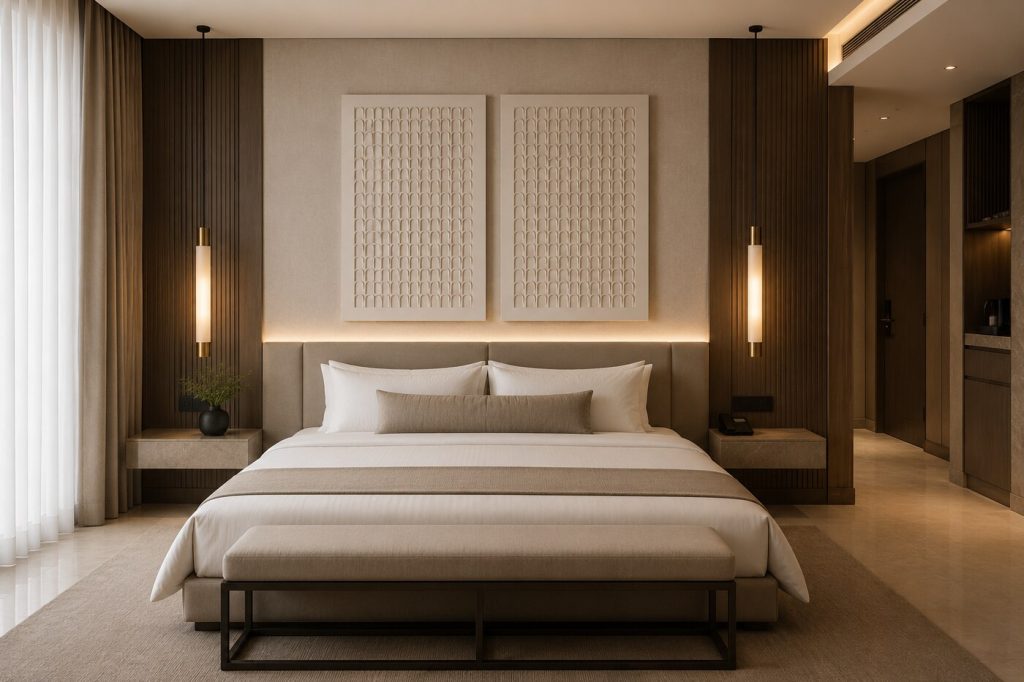
This is the part that can’t be reproduced. The texture has body, raking light draws shadows across the matter and each piece changes through the day, in an expressive way that a photograph simply flattens. For more on surface and relief, see textured paintings.
An original, not mass-produced decor
A lot of two-panel decor is the same image repeated in thousands of homes. An original diptych is different: texture you can touch, the artist’s signature and a certificate of authenticity that says it exists once, and it is yours. It comes with you to your next home. And you don’t need to be from the art world to choose it: you deal directly with Adriana, with no gallery or middlemen, and everything can be handled in English by WhatsApp or email.
Send me a photo of your wall
- Free personal advice: send a photo of your wall and Adriana looks at the light, tones, furniture and scale. Personal reply within 24 hours.
- A realistic simulation: see the work to scale on your own wall before deciding. Request your free simulation through the form.
- Made to order: if nothing fits, Adriana can paint a commissioned piece, adapting format, palette and composition to your space.
- Delivery across Spain with professional packaging; payment by Bizum or bank transfer.
To see everything she paints, start with her original abstract art.