Choosing between a 120×80 and a 150×100 cm canvas isn’t really a question of taste: it is a question of proportion. The right proportion lets a large wall breathe and makes the painting look as if it was made for that spot; the wrong one, however beautiful the work, leaves a gap that looks too small or a canvas that crushes the furniture beneath it. This wall art size guide brings together the most useful large formats, which wall and which piece of furniture each one suits, how high to hang it and how to test it at home before you decide. All wall art sizes here are given in centimetres, width by height (a 150×100 is 150 cm wide and 100 cm tall), with inches in brackets where it helps.
Wall art sizes: measure the wall first, then choose the art
The most common fear after a renovation or a move is getting the scale wrong. You invest in an original, hang it, and it looks lost above the sofa, or so big that the room seems to shrink. The way to avoid it is to measure before you look at paintings. You need three figures:
- The free width of the wall, leaving out doors, windows, sockets and corners.
- The width of the furniture that will sit below it: sofa, bed, sideboard or dining table.
- The ceiling height, and the distance from which you will look at the work most of the time.
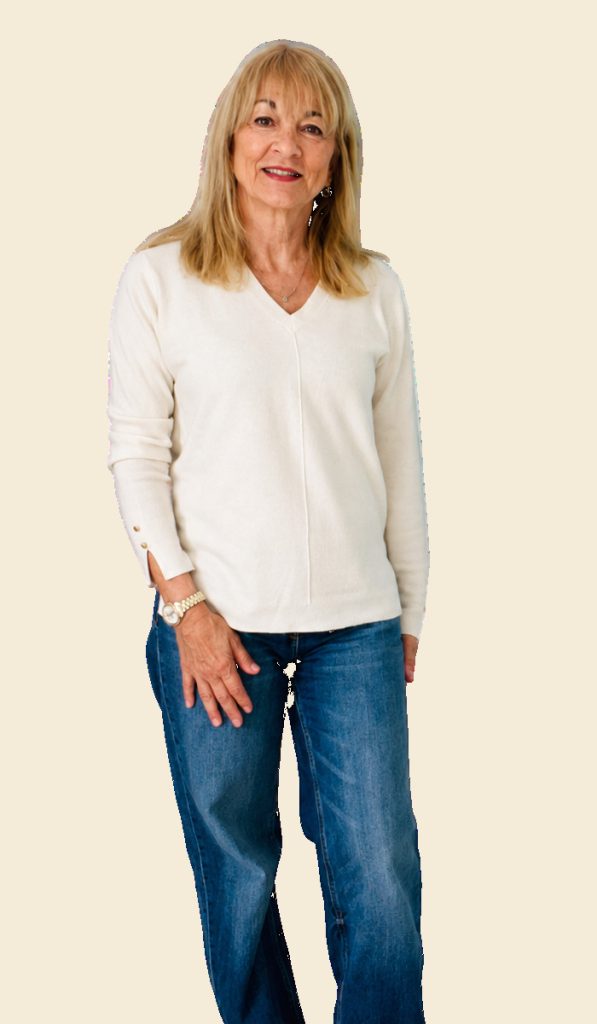
With those three numbers, the format almost chooses itself. And if you would rather not do the maths, send a photo of your wall: Adriana Fernández, who paints in her studio in Ibiza town, replies personally within 24 hours and prepares a realistic simulation of the piece on your own wall, free of charge and entirely in English, so you see the real scale before you commit.
The two-thirds rule
It is the guideline interior designers trust most: the width of the art should cover between two-thirds and three-quarters of the width of the furniture below it. Under half, the work floats and looks like a mistake; match or exceed the furniture and the two compete. Art that is too small for the wall space is a far more common error than art that is too big. Some real examples:
- 220 cm (87 in) sofa: a work 145 to 165 cm wide. A 150×100 or a 160×80 panoramic fits here.
- 180 cm (71 in) sofa: 120 to 135 cm wide; a 120×80 or a 130×75 sits in balance.
- 160 cm bed: 105 to 120 cm wide above the headboard.
- 200 cm sideboard: a long format of around 140×70, or a diptych whose overall width adds up to the same.
On a wall with no furniture, the rule changes: aim to fill roughly half to two-thirds of the free width, leaving air on either side; a wall is 9 feet wide (about 2.7 m)? Then a work of 135 to 180 cm suits it. There is more on this in our guide to art above a sofa.
Standard canvas sizes vs print sizes: large formats and where each one works
There is no official standard for original paintings, but some formats keep coming back because they work with everyday furniture. If you are used to the A-series print sizes of the ISO standard, the ones on any poster size chart (an A1 is 59.4×84.1 cm, an A2 42×59.4 cm, and A3, A4 and A5 are smaller still), a large original starts roughly where those stop: art print sizes rarely go much beyond that, while these canvases begin at a metre. These are the most useful large formats, with real works from the Mediterranean Collection 2026 in each one; other sizes are available on commission. Size is also one of the main factors behind what an original painting costs.
Large wall art sizes at a glance: a quick comparison chart
- 100×70 cm (39×28 in): chest of drawers, two-seater sofa, entrance hall.
- 120×80 cm (47×31 in): 180 cm sofa, double bed, dining room.
- 130×75 and 140×70 cm: long sofas and low sideboards.
- 150×100 cm (59×39 in): main living room wall, large bed.
- 160×80 cm (63×31 in): panoramic above a long sofa.
- 200×100 cm (79×39 in) and more: open-plan rooms and double heights.
- 105×104 cm squares: consoles and walls between windows.
Every format here is an original on canvas, so no frame size guide or print size guide applies: the work hangs unframed, edges painted.
100×70 cm (39×28 in): the versatile large format
The entry point to large formats. This format works above a chest of drawers, in a generous entrance hall or a wide corridor, or above a two-seater sofa. Turned vertical (70×100), it lengthens narrow walls and becomes a tall piece for a corner. A more distinctive alternative is a diptych: Equilibrio en Movimiento is two vertical 50×70 pieces that, hung together, cover just over a metre and speak of the fluidity of water.
120×80 cm (47×31 in): the classic above a sofa or bed
Probably the most forgiving format of all: right for a 180 cm sofa, a 150 or 160 cm bed and a dining room wall. Equilibrio en Pétalos (120×80), inspired by coastal erosion, and Límite Natural (120×80), with asphalt paint, are both in this format. A little taller, Horizonte en Calma (120×90) combines acrylic and matter; those extra ten centimetres give it more body under high ceilings.
130×75 and 140×70 cm: long formats for living rooms and sideboards
When the sofa grows or the furniture is low and long, it pays to stretch the work without raising it too much. Límites and Horizontes (130×75 each) work with paint, texture and asphalt paint; Materia Serena (140×70) goes for neutral tones and calm organic textures, ideal for a Japandi or wabi-sabi room. Close by is Geografía del Alma (139×90), about the place where land meets sea, with more height for an uncluttered wall.
150×100 cm (59×39 in): the main-wall size
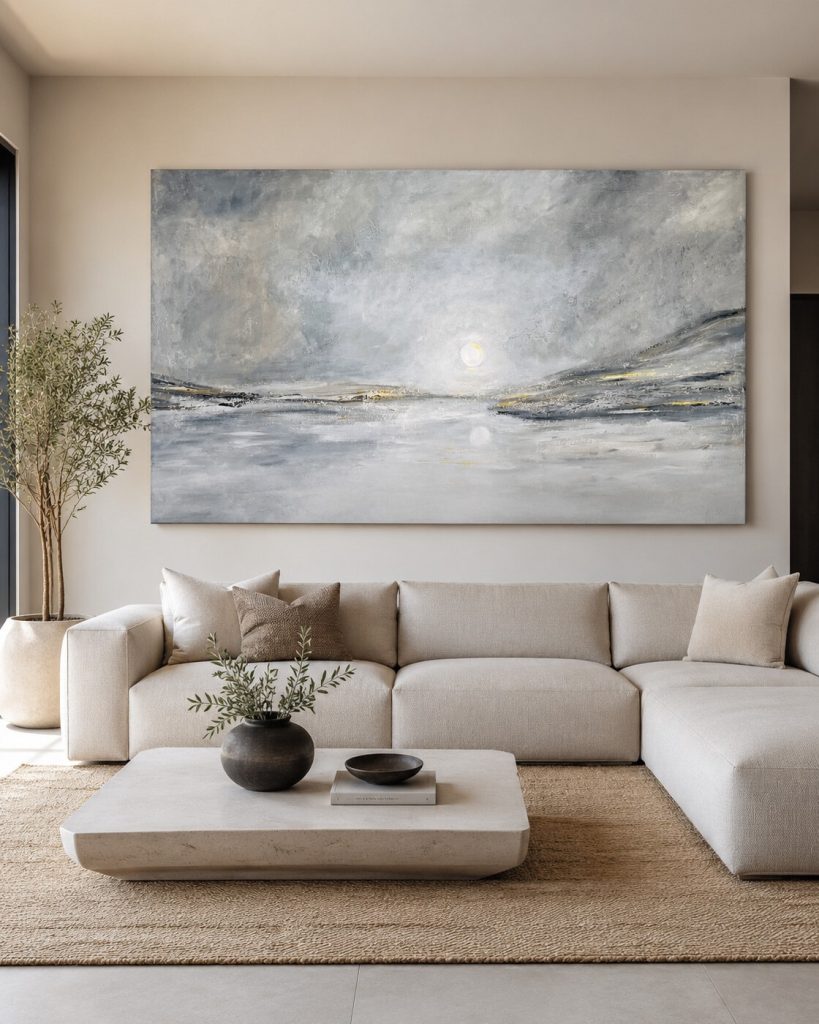
The 150×100 (or 100×150 in portrait) is the size people search for most, and with good reason: it fills the wall of a modern living room with a 220 or 240 cm sofa, the wall behind a large bed or the end wall of a dining room with real authority. It is the format at which a canvas stops being one more decorative element and becomes the focal point of the entire room. There is no piece of exactly 150×100 in the current collection, so this format is painted as a commission, with the composition and palette designed for your space. If something very close works for you, Geografía del Alma (139×90) is around that scale.
160×80 cm (63×31 in): the horizon panoramic
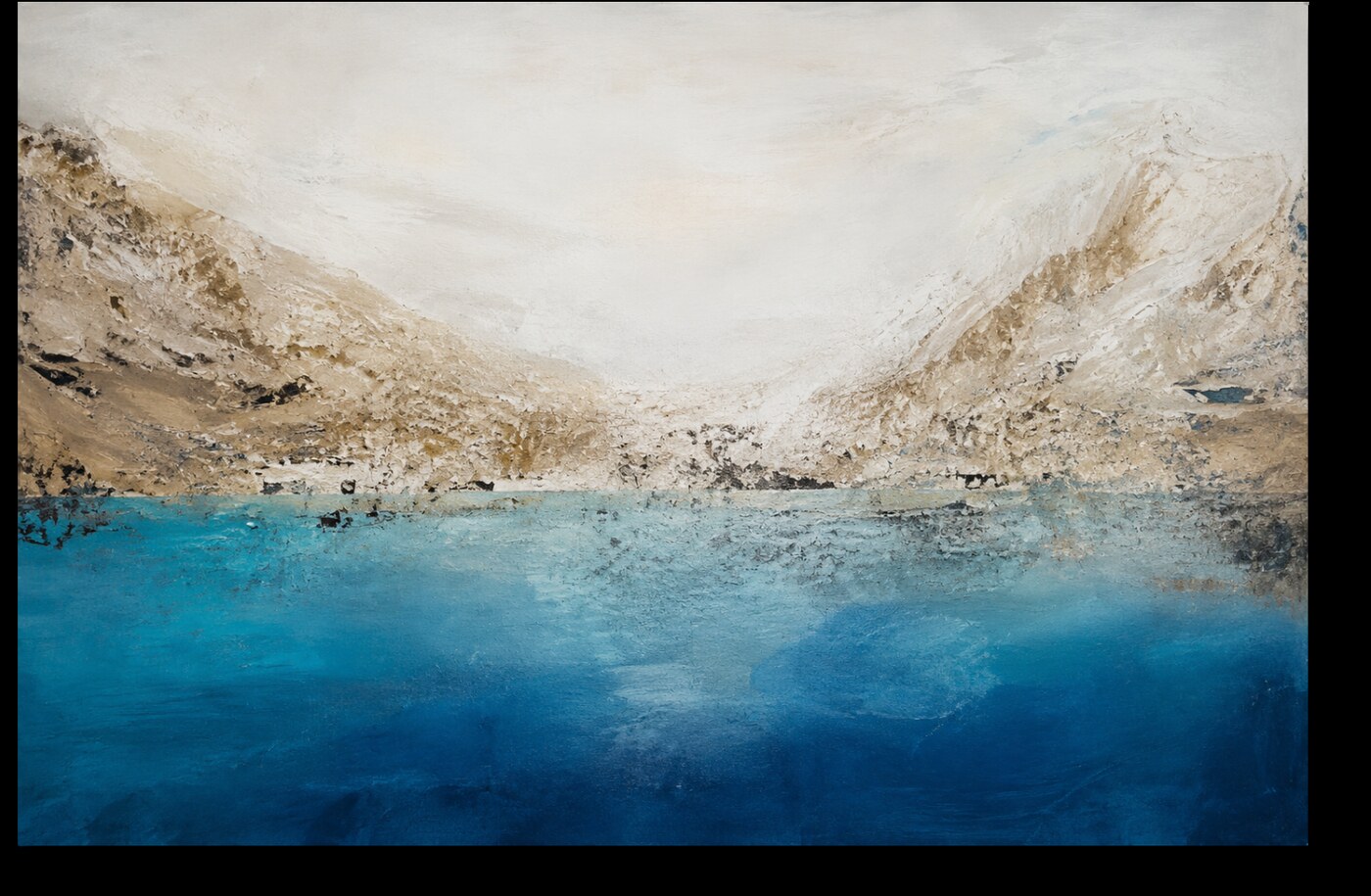
A 2:1 format is the canvas that understands a horizon best. Silencio de Horizonte (160×80), built from textures and acrylic glazes that hold the Mediterranean light, shows why: above a long sofa or a low sideboard, it opens the wall sideways rather than upwards, which is very useful with standard ceiling heights.
200×100 cm (79×39 in) and beyond: two metres or more
A 200×100 is for a wall with more than three metres free (around ten feet), open-plan living spaces, double-height rooms, reception areas or wellness spaces. Adriana regularly paints formats up to 2 metres wide, and larger on commission, so an oversized statement piece for a singular wall isn’t an exception but a made-to-measure project. At that scale, art stops being home decor or wall decor and starts to shape the architecture of the space.
Square formats: 100×100 and 105×104 cm
The square is the calmest shape: it pushes the eye neither sideways nor up. It works above a console table, on a narrow wall between two windows or as a single piece in a bedroom. Costa de Ibiza and Profundidades measure 105×104, practically a one-metre square (41×41 in). At the small end, the Mareas Serenas set is made of 30×30 pieces (12×12 in) in textured relief and acrylic, meant to hang together.
Diptychs, triptychs and sets
Splitting a work across several canvases lets you cover a lot of width with manageable pieces. Leave 5 to 8 cm (2 to 3 in) between panels and measure the total width of the set, not each piece: any less and they look stuck together, any more and they read as separate works. The Equilibrio diptych is two 60×50 pieces; Equilibrio en Movimiento, two vertical 50×70 pieces. For a very wide wall, a three-panel piece can be discussed as a commission, with the same spacing logic and a composition that flows from one canvas to the next. More ideas in diptych and triptych art.
 Silencio de Horizonte160 × 80 cmTextures with acrylic glazesPrice on requestAsk about this piece →
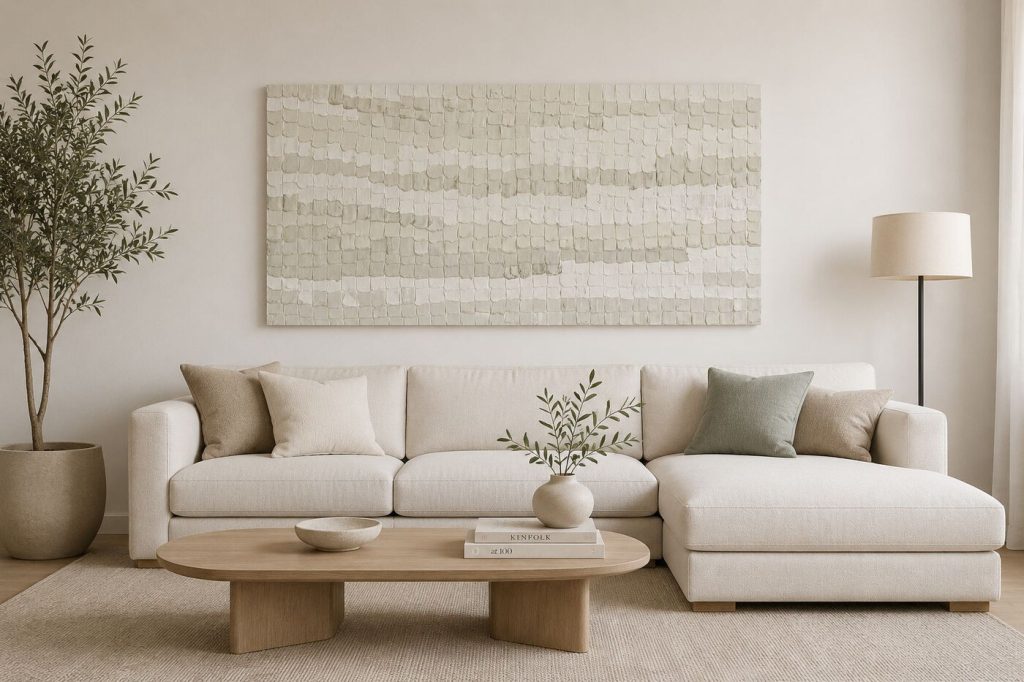 Materia Serena140 × 70 cmPaint and texture on canvasPrice on requestAsk about this piece →
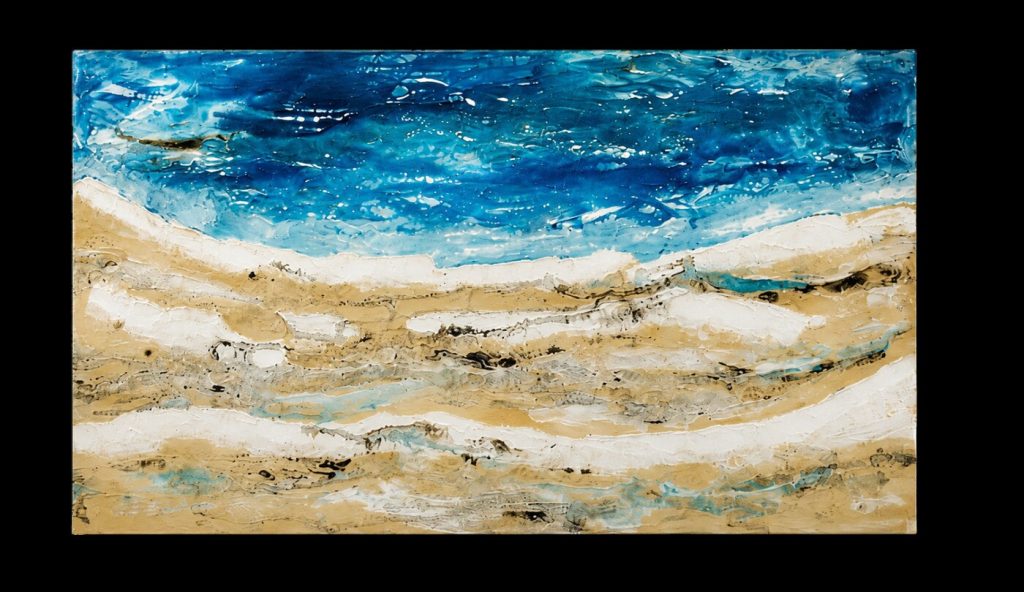 Límites130 × 75 cmPaint, texture and asphalt paint on canvasPrice on requestAsk about this piece →
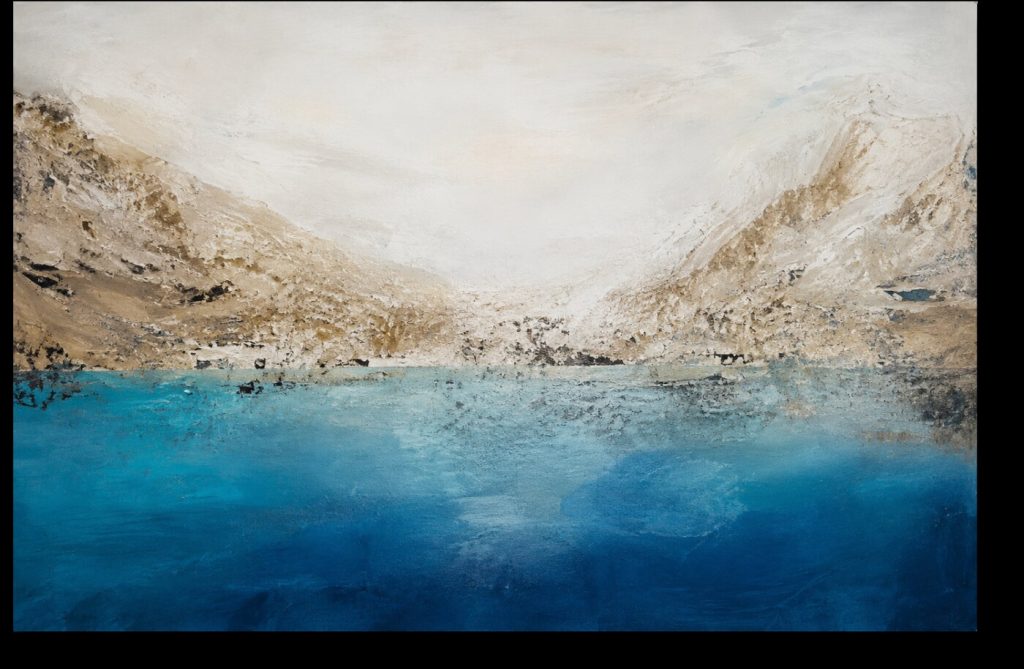 Horizontes130 × 75 cmPaint, texture and asphalt paint on canvasPrice on requestAsk about this piece →
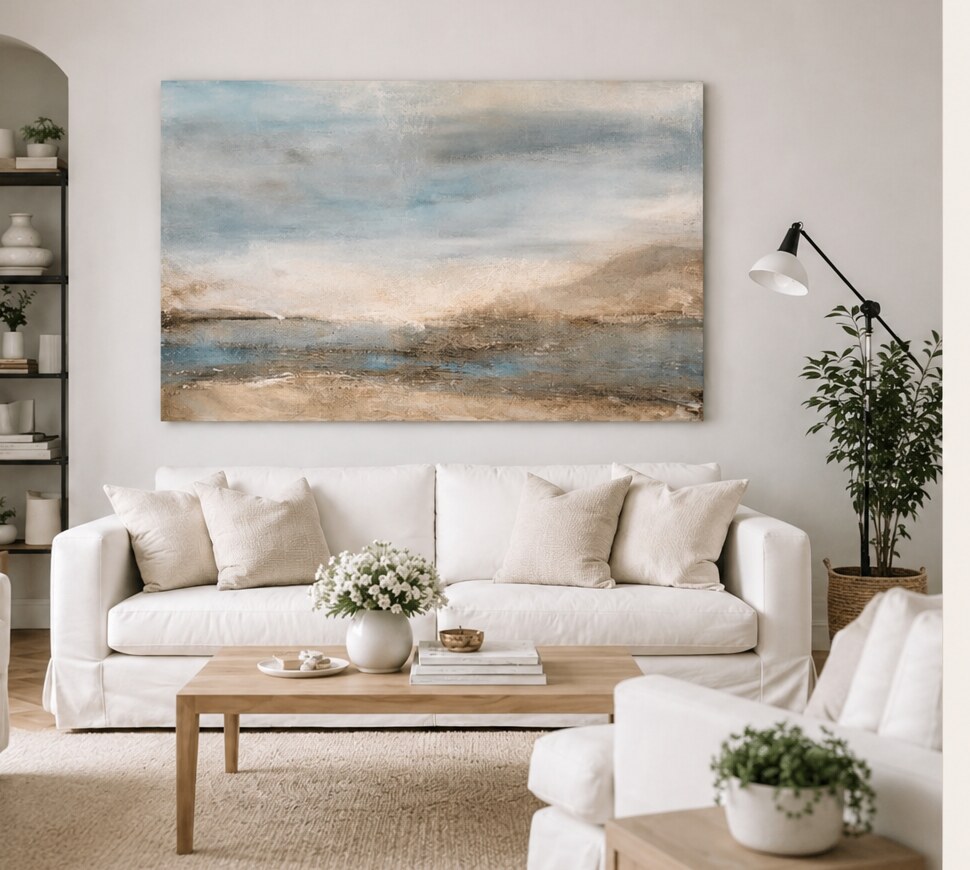 Horizonte en Calma120 × 90 cmAcrylic and textured matterPrice on requestAsk about this piece →
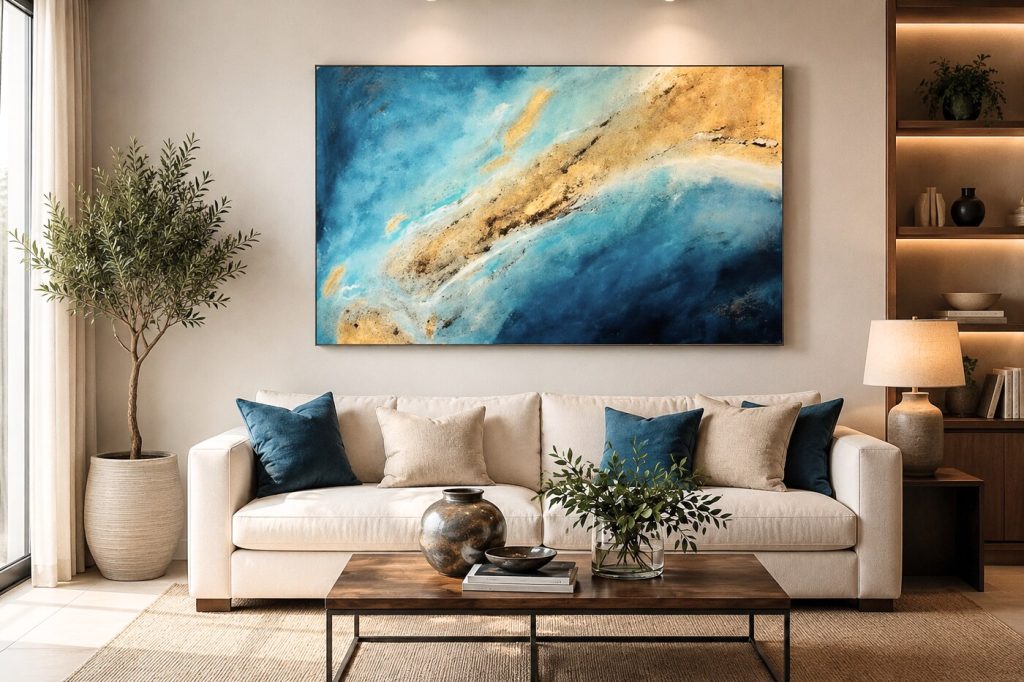 Geografía del Alma139 × 90 cmTextured paint on canvasPrice on requestAsk about this piece →
Landscape, portrait or square: matching the canvas to the wall
Orientation matters as much as dimensions. A simple rule: the work echoes the shape of the space it occupies. A landscape format accompanies low, long furniture; a portrait one accompanies tall gaps. In abstract art, orientation also changes the rhythm: horizontal suggests horizon and calm, vertical suggests lift.
- Landscape: above sofas, beds, sideboards and dining tables. It is the natural orientation for large living room art.
- Portrait: the original equivalent of a portrait print or vertical print, for narrow spaces, beside a staircase, in an entrance or next to a window. Large vertical wall art also makes a high ceiling feel even higher.
- Square: to bring balance, on walls of almost square proportion or in symmetrical two-piece arrangements.
What size art for a living room, bedroom or dining room
Each room reads scale differently, and no single format suits every one of them. A gallery wall of small pieces can work in a hallway, wherever the art fits around doors, but a living room wall usually asks for one strong original rather than a cluster of smaller prints.
- Living room: the wall you look at from furthest away, so it welcomes large formats. With a three-seater sofa, think 140 to 160 cm wide; with a four-seater or a chaise longue, a 150×100, a 160×80 or bigger. For real visual presence, see our large abstract paintings.
- Bedroom: above the headboard, 105 to 120 cm wide for a double bed, in calm palettes. More ideas in bedroom wall art.
- Dining room: take the length of the table as your reference, not the wall; a work two-thirds the length of the table centres the whole scene.
- Home office: behind the desk, a 120×80 or a 130×75 gives presence without distraction; in a large meeting room, think 150×100 or more.
- Entrance and corridors: portrait or square formats. Here you look from close up, and a textured surface, like that of our textured paintings, is a particular pleasure.
How high to hang large wall art
The right format hung at the wrong height still looks wrong. Two references cover almost every case:
- On a free wall: the centre of the work around 145 to 155 cm (57 to 61 in) from the floor, the average eye level. It is the standard used by museums and galleries, and it works at home.
- Above a sofa, bed or sideboard: the bottom edge 15 to 30 cm (6 to 12 in) above the back of the sofa, the headboard or the top of the furniture, so the art and the furniture read as one.
A frequent mistake is hanging too high, almost touching the ceiling. If in doubt, go lower: a large work close to the furniture anchors the whole arrangement.
Viewing distance and ceiling height
The further away you stand, the larger the work can be. As a rough guide, a piece 150 cm wide is best enjoyed whole from two or three metres; in a six-metre open-plan room, a small format simply disappears. At the same time, works with matter also ask you to step close: from afar you see the composition, and as you approach, the texture, the relief and the way raking light changes the surface through the day. That is why a photograph, let alone a canvas print, never quite conveys an original painting: the raised brushstrokes, the matter and the nuances between beige, blues, greys and blacks only fully appear in person.
Ceilings count just as much. At a standard height of around 250 to 270 cm, landscape and panoramic formats add breadth without crowding. In double-height rooms, homes with high ceilings or stairwells, a portrait work or a format of two metres or more fills a volume that a 120×80 can’t reach.
A wall art size guide template you can make at home
The best way to get it right is to see the canvas art on your own wall, not on a product page. Three simple tricks:
- Masking tape: mark the exact outline of the format on the wall, at the height you would hang it.
- Paper template: join sheets of brown paper or newspaper up to the real dimensions and tape them up. You see the volume, not just the outline.
- A photo from across the room: take it from where you will sit. Leave it up for a couple of days: if you get used to it and want more, go up a format.
The next step is the most reliable one: “send me a photo of your wall”, as Adriana puts it. She looks at the light, the tones, the furniture and the scale, and sends you a realistic simulation of the work in your space. The advice is personal and free, so you decide with the image in front of you, not blind.
Framed or unframed? How a large original canvas arrives
Every work is painted by hand in tones inspired by the Mediterranean, in acrylic with matter, texture and asphalt paint, and arrives stretched on a wooden stretcher frame and signed: ready to hang. Paint and texture continue around the edges, so the frame question answers itself: it hangs without a frame and looks finished from the side too, and frame sizes simply don’t come into it. Each piece comes with a certificate of authenticity and is delivered anywhere in Spain with professional packaging. You deal directly with the artist, with no middlemen, and payment is by Bizum or bank transfer.
A blank wall no catalogue fits: a work painted for it
Sometimes a wall asks for a canvas that isn’t in any collection: an exact 150×100, a 200×100, a very long panoramic or something over two metres. That is what a commissioned painting is for: you set the size, composition and palette for your space, and Adriana paints it for that specific wall. It is the usual route for interior designers and homeowners working with an unusual wall. If you prefer something quieter, take a look at our minimalist wall art.